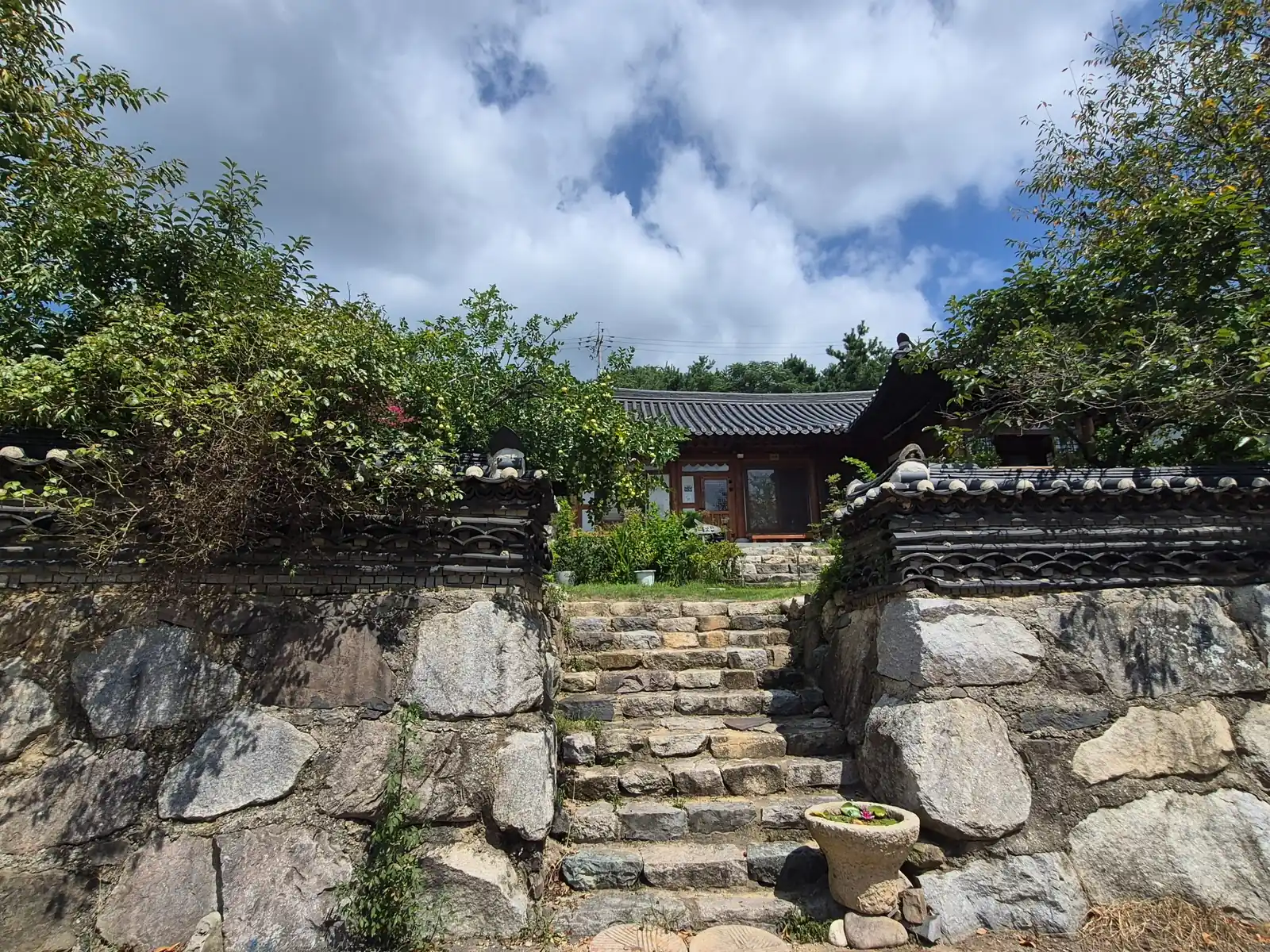
When people first notice a traditional Korean house, or hanok, their eyes usually go to the roof.
The dark gray tiles, curved rooflines, wooden columns, and wide eaves are some of the most recognizable features of traditional Korean architecture.
But when I walk through rural areas of Korea, there is another feature that often catches my attention: the walls surrounding the houses.
Some are made mainly from stone. Others combine earth, stones, and pieces of traditional roof tile. Sometimes plants grow over them, making the wall feel like part of the landscape rather than simply a barrier.
These walls may look simple at first, but they are an important part of the visual character of traditional Korean homes and villages.
A Wall Was More Than Just a Fence
Traditional Korean houses were not designed as isolated buildings.
The house, courtyard, gate, walls, and surrounding landscape worked together to create the living space.
The courtyard, known as a madang, was particularly important in a hanok. It was an open area used for everyday activities and gatherings, while different buildings or rooms could have different functions within the household.
A wall helped define where this domestic space began and where the village road ended.
It could also provide separation between the private space of the household and people passing outside.
This becomes easier to understand when walking along an old Korean village road. Instead of seeing directly into every yard, you often experience the village as a sequence of walls, gates, roofs, trees, and narrow paths.
The wall is therefore not separate from the house.
It is part of the way the entire space is experienced.
What Were Traditional Korean Walls Made From?
There was no single type of traditional Korean wall.
Materials and construction varied according to the location, available materials, period, household, and purpose.
Stone was an obvious material in places where it was readily available. Earth was also widely used, and traditional walls could incorporate bricks, stones, and pieces of broken roof tiles.
The Korea Heritage Agency notes that stones or broken roof tiles were sometimes inserted into earthen walls to help stabilize them. Decorative walls could go further, incorporating tile fragments and patterns into the surface.
That is particularly interesting when looking closely at the wall in this photograph.
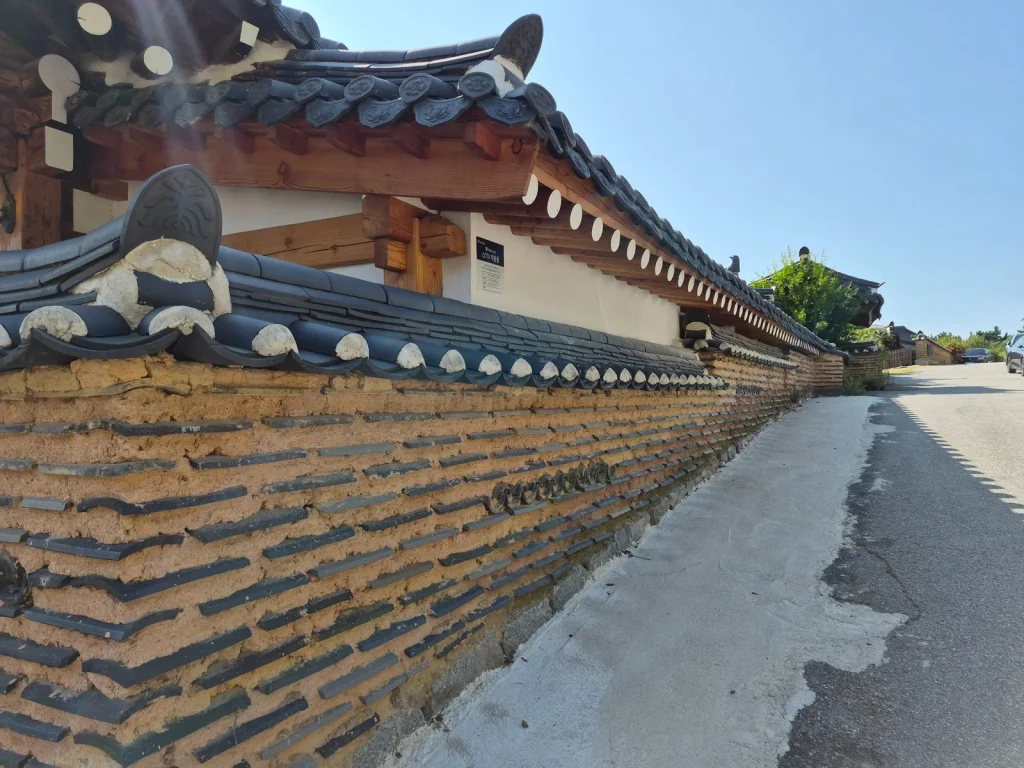
Rather than being a plain concrete surface, the wall contains repeated horizontal rows of dark tile pieces between layers of earth-colored material.
Larger roof tiles cover the top.
I cannot determine the exact age or traditional construction method of this particular wall from a photograph alone. But visually, it demonstrates how materials associated with Korean traditional architecture can create both structure and decoration.
Why Put Roof Tiles on Top of a Wall?
Look at many traditional-style Korean walls and you will notice something familiar at the top: giwa, the same type of curved tile associated with hanok roofs.
There is a practical reason for covering structures with roof tiles.
Traditional roof tiles are designed to deal with rain and moisture and protect the material beneath them. The Korea Heritage Agency describes protection from rain and moisture as the fundamental function of roof tiles, alongside their architectural beauty.
On a wall, a tiled top similarly helps shield the vulnerable upper surface while also visually connecting the wall with the roof of the house.
That combination is one reason these walls look so naturally connected to hanok architecture.
The roof and wall speak the same visual language.
When a Wall Becomes Part of the Landscape
One of my favorite things about traditional Korean walls is what happens when nature begins to grow around them.
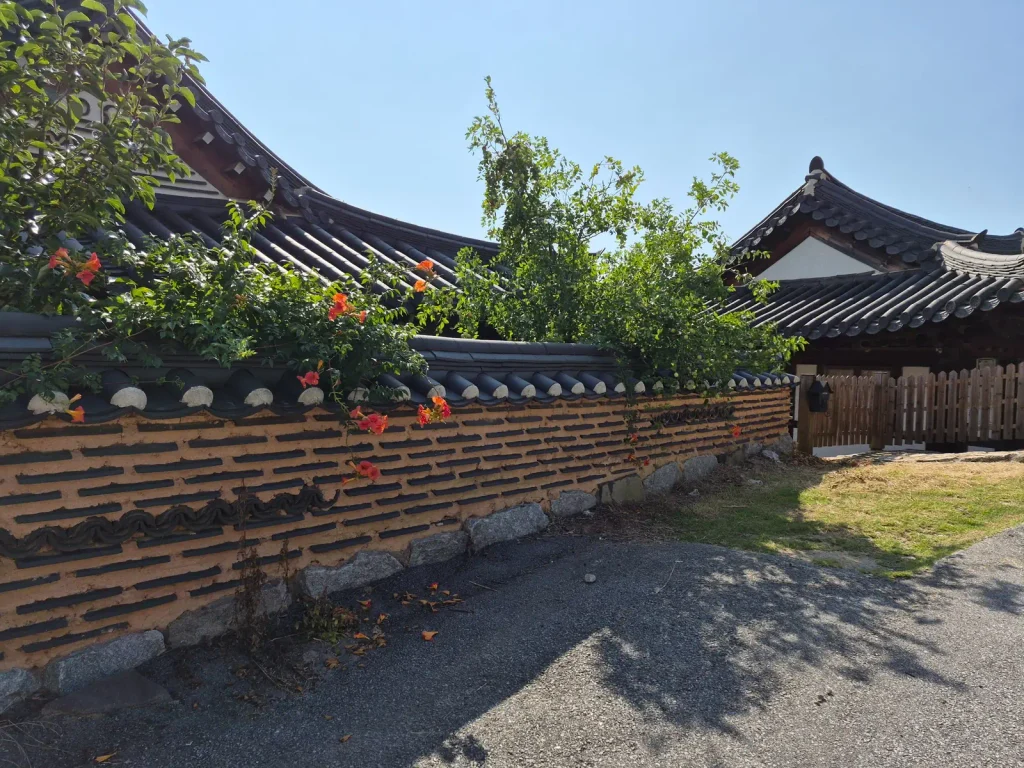
In this photograph, orange flowers and green branches spill over a wall made with earth-colored material and dark tile pieces.
Behind it are the curved roofs of hanok buildings.
There is no dramatic monument here.
It is simply a wall beside a house.
And yet this kind of small scene is one of the things that gives older Korean villages their character.
Traditional Korean architecture has long placed importance on its relationship with the surrounding natural environment. Official Korean heritage material describes the use of natural materials and harmony with the surrounding landscape as characteristic features of hanok.
A wall covered by plants illustrates that relationship on a very small scale.
Stone, earth, tile, trees, flowers, and wooden buildings all become part of one view.
The Walls Can Tell the Story of a Village
Some old Korean village walls are considered culturally important enough to preserve in their own right.
For example, historic village walls in places such as Gangjin, Muju, and Iksan have been registered as Korean cultural heritage. The heritage description for Gangjin’s old village walls specifically notes that the stone-wall lanes preserve the atmosphere and character of a traditional rural village.
That tells us something important.
A village’s history is not contained only in its grandest building.
Sometimes it survives in an ordinary lane.
A stone wall.
An old gate.
Or a row of roof tiles running along the edge of someone’s yard.
Something Easy to Miss in Rural Korea
If you visit a famous hanok village in Korea, you will probably take photographs of the houses.
But if you travel through the Korean countryside, look a little lower.
Look at the walls.
You may find large stones stacked beneath a house, layers of earth and tile, small gates leading into courtyards, flowers growing over tiled walls, and narrow roads shaped by property boundaries that have existed far longer than the cars now driving beside them.
Not every wall is ancient, and not every traditional-looking wall was built using exactly the same historical technique.
That distinction matters.
But together, these walls preserve a visual language that remains strongly associated with traditional Korean architecture.
Final Thoughts
A hanok wall may not be as impressive as a palace or as famous as a traditional tiled roof.
But that may be exactly why it is interesting.
It belongs to everyday life.
People walked beside these kinds of walls, entered through gates, worked in courtyards, and lived behind them.
Even today, when I see earth-colored walls, rough stones, dark roof tiles, and plants spilling into a quiet rural road, they immediately create a landscape that feels distinctly Korean.
Sometimes understanding Korea is not about looking for the biggest landmark.
Sometimes it is about noticing the wall beside the road.