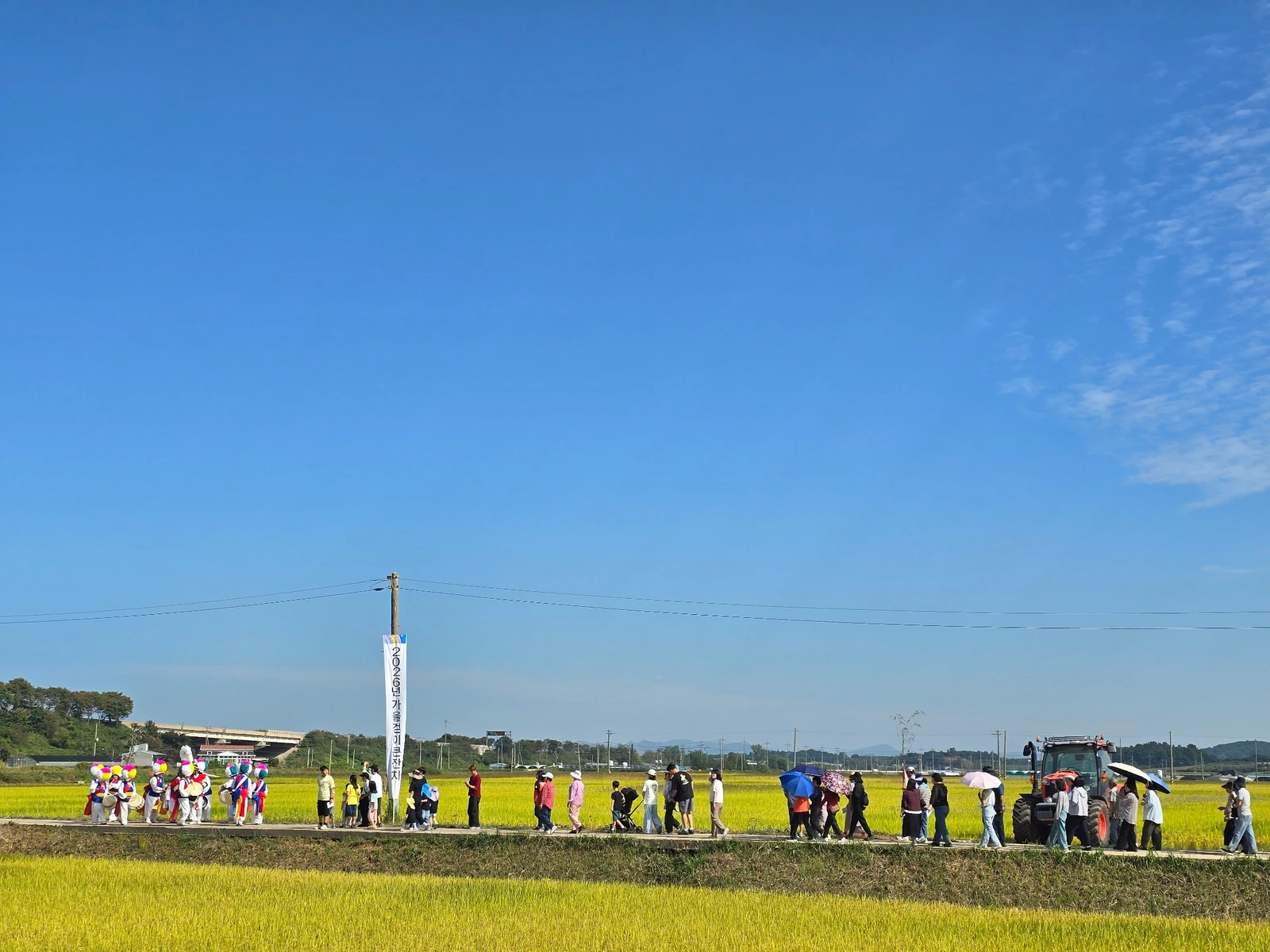
Autumn is one of the most important seasons in rural Korea.
Rice fields that were green throughout the summer gradually turn golden, harvesting machines begin appearing beside country roads, and farming villages prepare for the rice harvest.
But harvest season is not only about work.
On September 19, 2026, an autumn harvest festival was held in Myoryang, a rural township in Yeonggwang County, South Korea. From 10 a.m. to 3 p.m., a normally quiet area surrounded by rice fields became a gathering place for the local community.
Children from the local elementary school, families, farmers, and elderly residents all came together. Several generations who live in the same rural community shared the same festival.
A Festival Held Among the Rice Fields
The location was an important part of the festival.
This was not an event held in a stadium or a large city park. It took place beside working rice fields, surrounded by narrow farm roads, mountains and agricultural land.
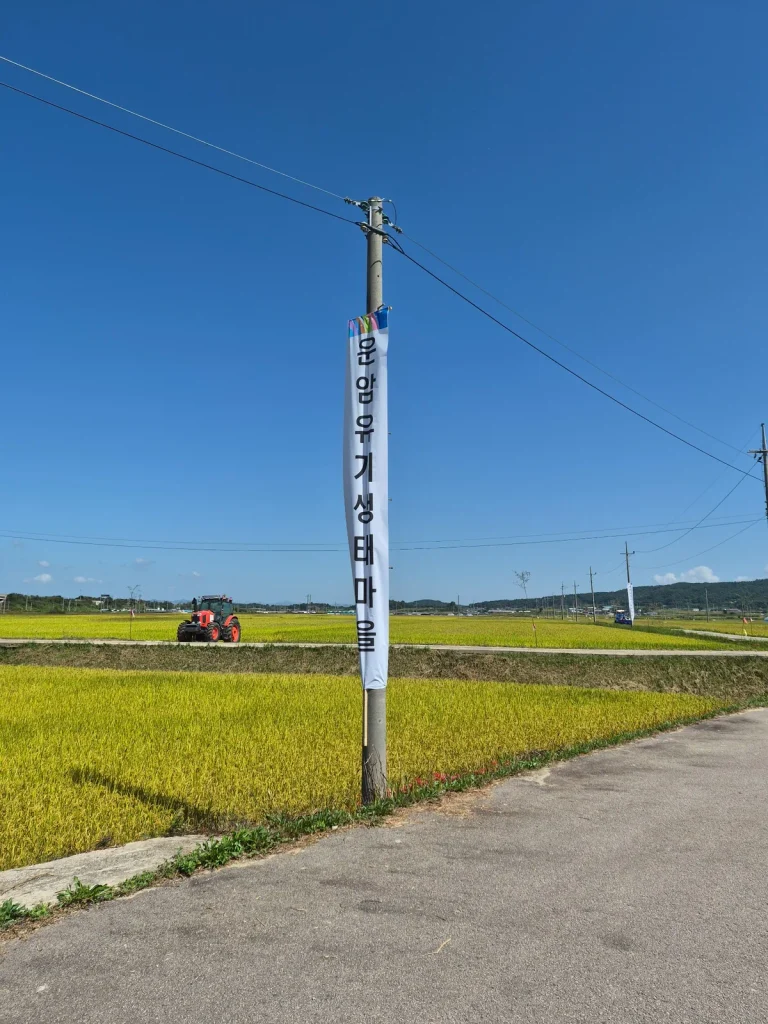
Most of the time, this is simply part of the everyday landscape of Myoryang.
People pass these fields on ordinary days. Farmers work here. Tractors travel along the narrow roads.
But on this day, the same quiet agricultural landscape became the setting for a community celebration.
And before the festival really got underway, there was a sound that immediately changed the atmosphere.
The Festival Begins With Pungmul
In many rural Korean communities, traditional percussion music can be part of the beginning of a local celebration.
Myoryang has its own local pungmul group.
Before the main festival activities began, the group gathered in colorful traditional costumes with drums, gongs and other percussion instruments.
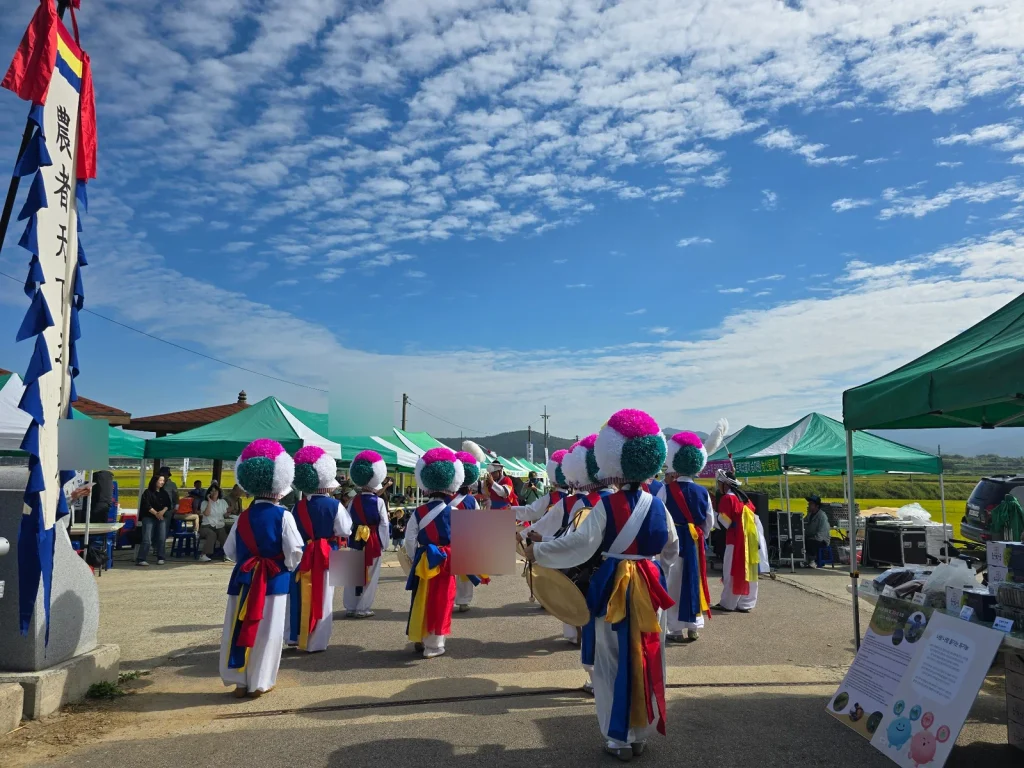
Then the music began.
The sound of drums and gongs carried across an area that would normally be filled with the quieter sounds of farming and village life.
Pungmul (풍물) is a Korean folk tradition combining percussion, movement, dance and community participation, with strong historical connections to agricultural and village culture.
Here, however, the musicians were not simply performing on a stage for people to watch.
They were announcing that the festival was beginning and creating excitement for the day ahead.
Following the Music Through the Fields
As the pungmul group began moving along the narrow farm road, people followed behind them.
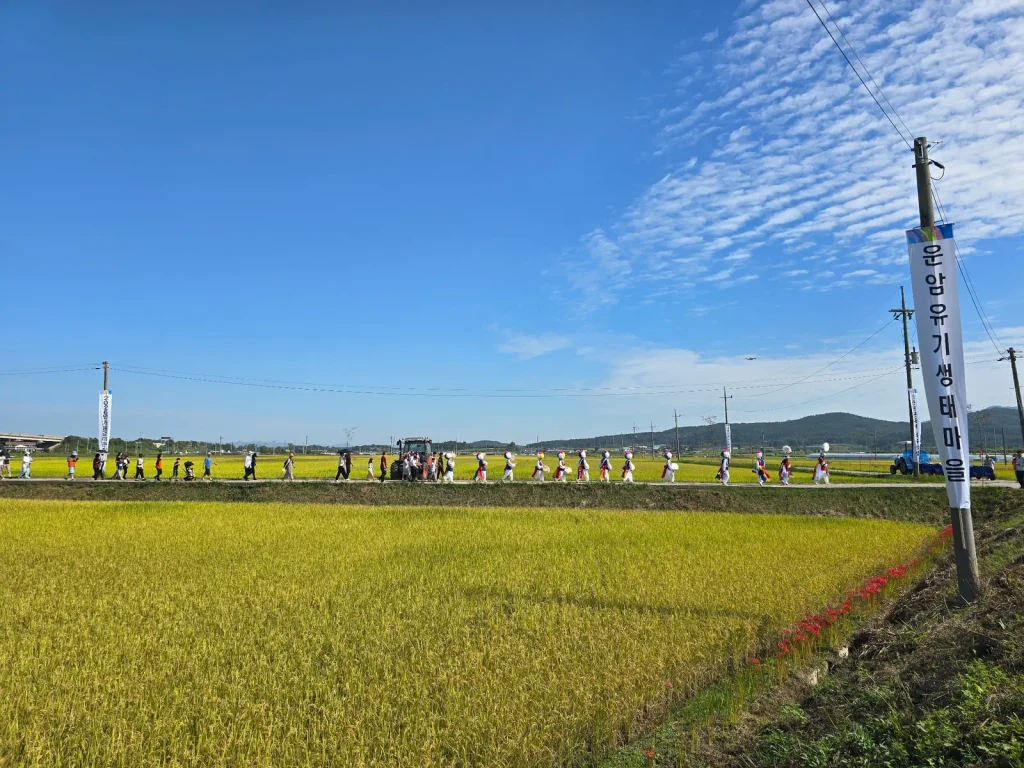
The musicians led the way through the rice fields while residents and visitors joined the procession behind them.
Children, adults and older residents were all part of the same scene.
The procession was not separated from the village or the surrounding farmland. It moved directly through the landscape where people live and farm.
That made the beginning of the festival feel less like watching a scheduled performance and more like the community starting the celebration together.
Against the golden rice fields and blue autumn sky, the colorful pungmul costumes were especially striking.
Harvest Season Is Everywhere
Once you looked beyond the festival itself, there was another important part of the scene: farming.
The rice was approaching harvest, and agricultural machinery could be seen around the fields.
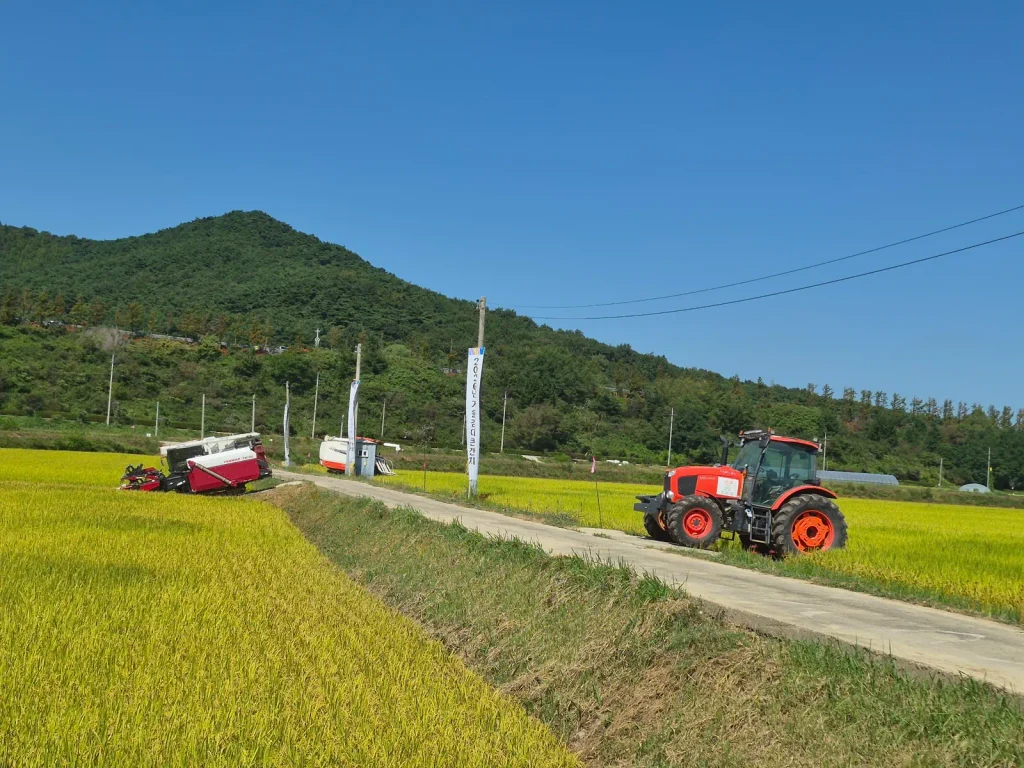
Tractors and harvesting equipment were also used around the festival area to help express the atmosphere of the harvest season.
For someone visiting rural Korea for the first time, these machines might look like part of a special display.
But they are also machines that belong to everyday agricultural life.
Around this time of year, tractors and harvesting equipment become increasingly visible as farmers prepare to bring in the rice.
The festival was not recreating harvest season.
Harvest season was actually happening all around it.
A Tractor Train Through the Rice Fields
One of the more unusual sights at the festival was a tractor pulling a line of small passenger carts.
It was a tractor train.
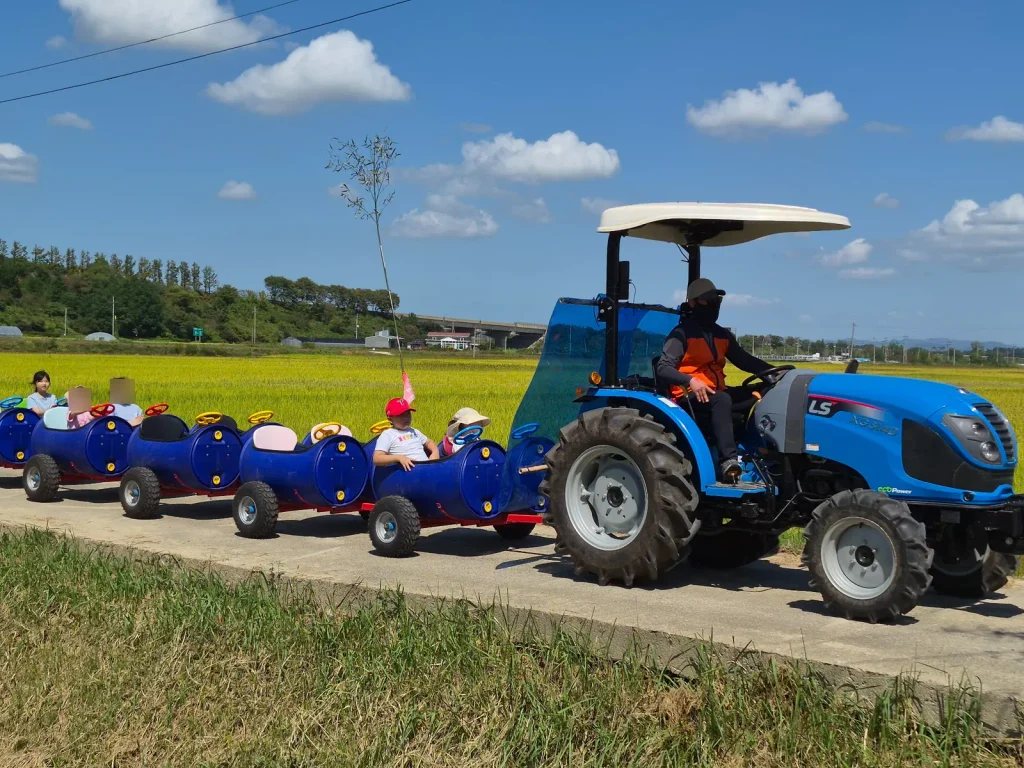
Participants could climb aboard and take a ride around the farm roads beside the rice fields.
It was simple, but it suited this festival perfectly.
A machine normally associated with farming became part of the celebration, carrying people through the same agricultural landscape that the festival was celebrating.
For children, especially, an ordinary farm road became something completely different for a few minutes.
One Festival, Several Generations
Perhaps the most meaningful part of a small rural festival is not any single performance or activity.
It is who comes.
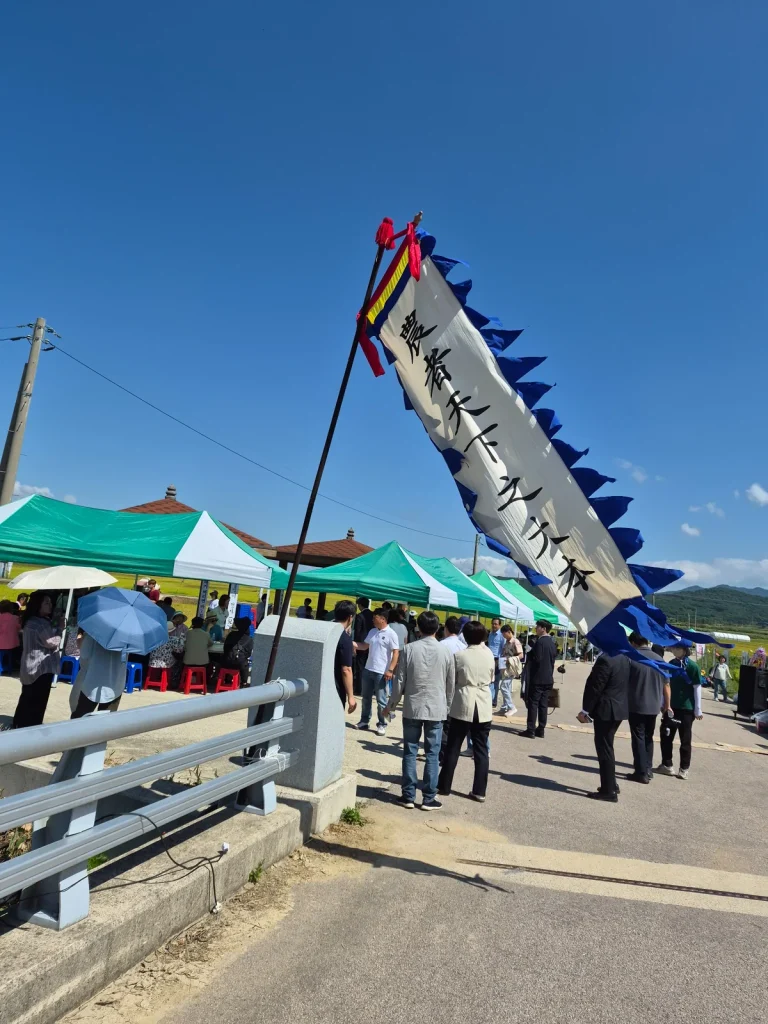
In Myoryang, the festival brought together people of very different ages.
Elementary school children could be there alongside their parents and grandparents’ generation. Farmers, families and elderly residents all shared the same space.
In a large city, people of different generations often spend their days in very different places.
A small rural community can be different.
The school, farms, village organizations and older residents are all parts of the same local community. An event like this gives them a reason to gather in one place.
That is something a photograph of golden rice fields alone cannot show.
When an Ordinary Rural Landscape Becomes a Festival
For most of the year, this is simply countryside.
There are rice fields, narrow roads, farm machinery and mountains in the distance.
Then, for one autumn day, the landscape changes.
Pungmul musicians lead people through the fields. Children ride behind a tractor. Neighbors meet one another. Several generations of the community gather in the same place.
And a quiet agricultural area becomes a festival ground.
A few hours later, the event ends and the countryside returns to its everyday rhythm.
That temporary change says something important about rural Korea.
The festival does not need to be separated from everyday village life because everyday village life is what gives the festival its meaning.
In Part 2, we will look more closely at the people themselves — how different generations spent the day together and what a small village festival feels like from inside the crowd.