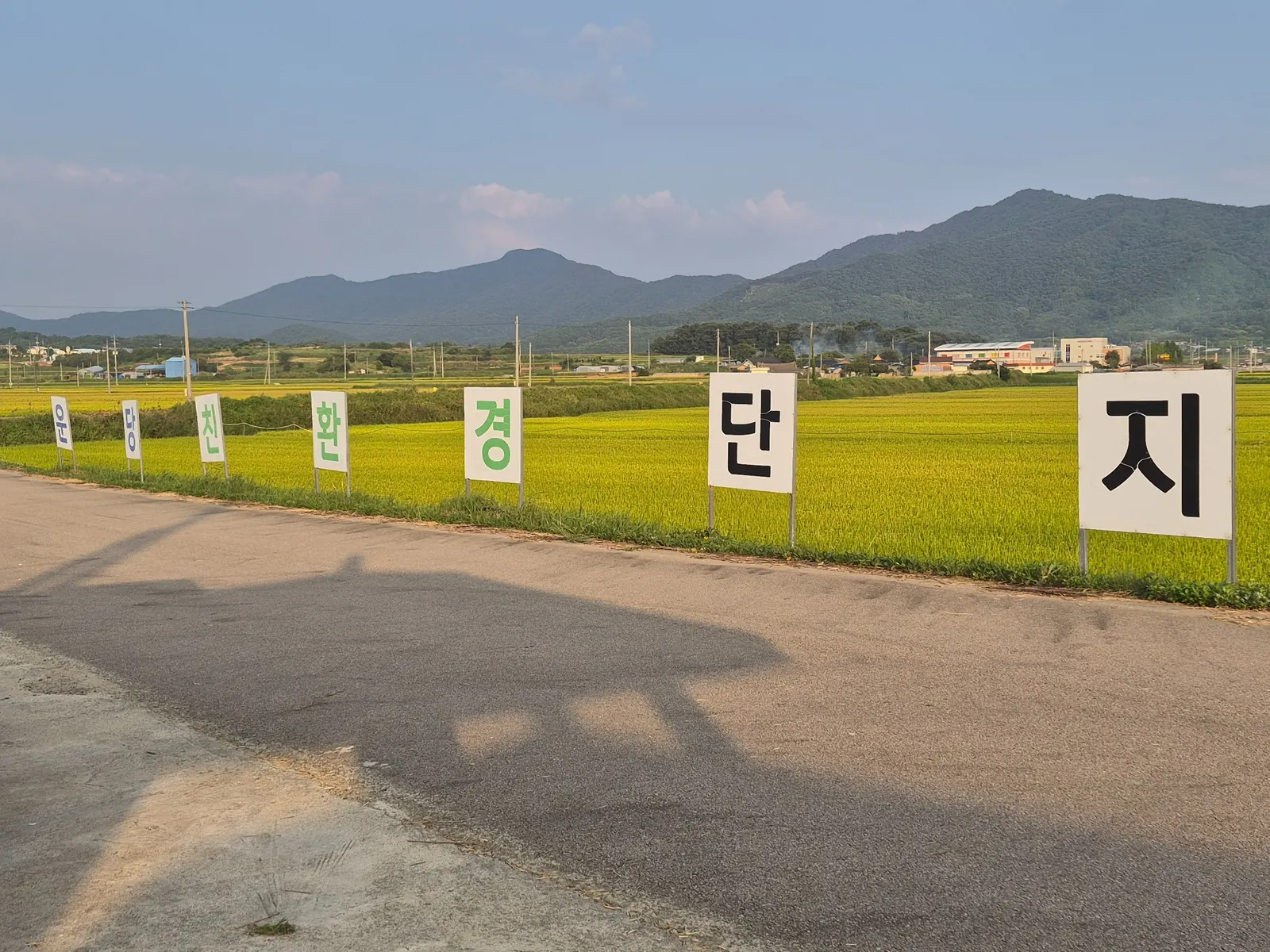
At first glance, there is nothing unusual about these rice fields.
A narrow farm road runs between the paddies. Rice stretches toward the mountains, utility poles follow the road, and small villages can be seen in the distance.
It looks like an ordinary farming landscape in rural Korea.
But this particular area near my home in Yeonggwang, Jeollanam-do, has another story.
It is marked as an eco-friendly agricultural complex.
And once you stop and read the signs beside the fields, an ordinary rural landscape begins to reveal how farming here is actually organized.
A Sign Tells the Story Behind the Fields
I pass landscapes like this regularly because this farming area is close to where I live.
Most of the time, rice fields simply look like rice fields.
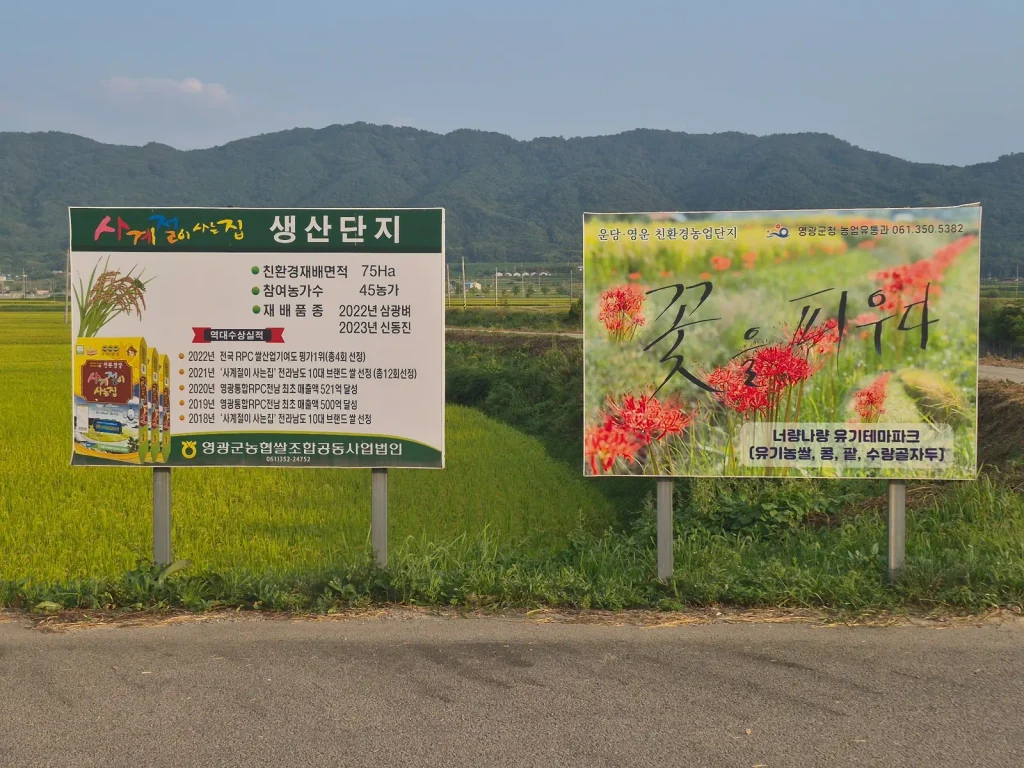
But the large signs beside this road tell you something that cannot be seen from the landscape alone.
One of them identifies this as the Undang and Yeongun Eco-Friendly Agricultural Complex.
Even the name is very local.
Undang refers to Undang-ri. Yeongun is a name formed from Yeongdang-ri and Undang-ri.
These are the kinds of small place names that rarely mean anything to an overseas visitor, but they matter in rural Korea. Farming areas are connected not only to counties and towns but also to individual villages and the people who live and farm there.
75 Hectares and 45 Farming Households
The other sign gives us an idea of the scale.
It lists:
Eco-friendly cultivation area: 75 hectares
Participating farms: 45
Seventy-five hectares is about 750,000 square meters, or roughly 185 acres.
That changes the way you look at the landscape.
What appears to be a collection of separate rice paddies is connected to a farming area involving dozens of local farms.
Each field may look small when viewed from the road, but together they cover a considerable area.
The sign also records rice varieties grown here in different years, including Samgwang in 2022 and Sindongjin in 2023.
This is not information most people would notice while driving past.
But for the people farming these fields, the names of rice varieties, the size of the cultivated area, and the participating farms are part of everyday agricultural life.
What Does Eco-Friendly Farming Mean Here?
The Korean words 친환경 농업, or eco-friendly agriculture, appear frequently in discussions about Korean farming.
In Korea, it is more than a vague expression for farming that seems environmentally friendly.
The country has an official system for eco-friendly agricultural production and certification, including categories such as organic and pesticide-free agricultural products.
The broader idea is to reduce reliance on synthetic pesticides, chemical fertilizers, and other chemical inputs while protecting the agricultural environment.
But standing here, none of that looks particularly complicated.
There are no futuristic farming machines or unusual-looking fields.
There is rice.
There is soil and water.
There are farmers.
And there are signs showing that the fields are part of an eco-friendly agricultural area.
The Small Signs Beside the Rice
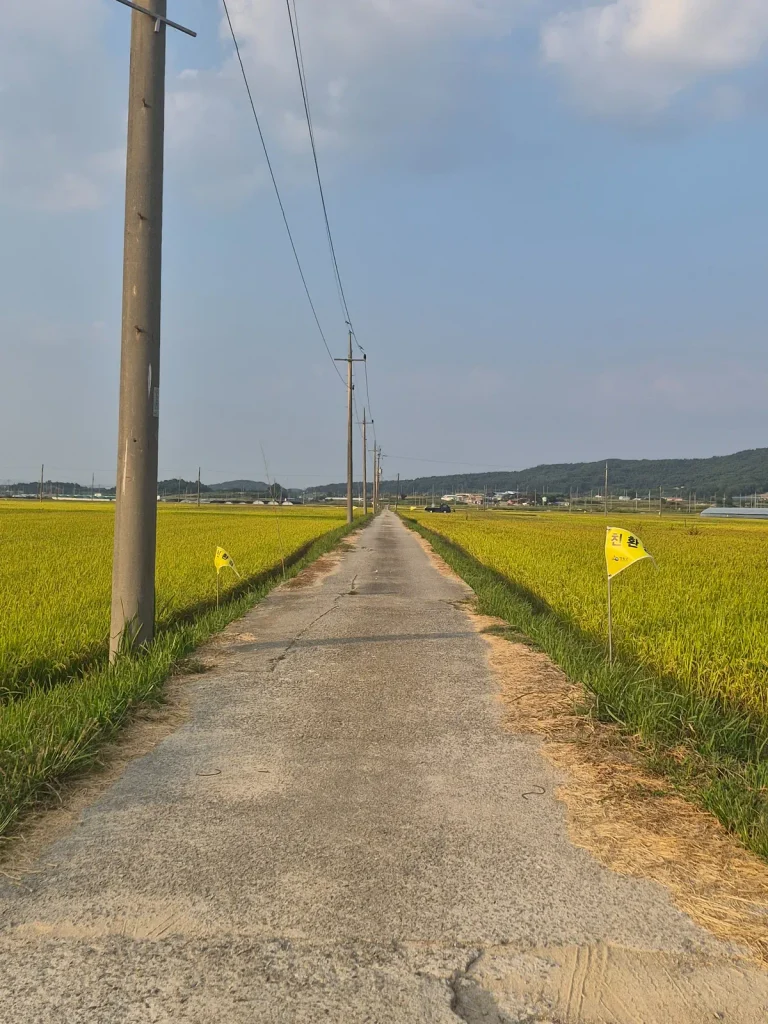
Walk farther into the fields and the large information boards disappear.
Instead, there are much smaller signs.
The yellow markers beside the rice carry the Korean word 친환경, meaning eco-friendly.
I think this photograph shows the area better than a long explanation can.
There is a narrow concrete road stretching straight ahead.
Rice grows on both sides.
Utility poles disappear into the distance.
Mountains surround the farmland.
And beside the rice are small signs identifying the eco-friendly farming area.
Without those signs, most people would probably see nothing more than another beautiful rice-field landscape.
Rice Fields Are Working Landscapes
For visitors, Korean rice fields can be beautiful.
In summer they are intensely green.
As autumn approaches, they slowly change to yellow and gold.
With mountains behind them, they can almost look like a postcard.
But for people living here, these fields are not scenery first.
They are places of work.
Farmers prepare the land, manage water, grow the rice, watch the weather, deal with pests and disease, and eventually harvest the crop.
A photograph captures only one quiet moment.
The farming continues for months.
That is an important difference between seeing rural Korea as a visitor and living around it.
The landscape may look peaceful, but a great deal of work is happening behind that peaceful appearance.
Farming Can Be a Community Effort
The number on the sign that interests me most is not 75 hectares.
It is 45 farms.
It reminds us that a large agricultural landscape is not necessarily the work of one huge farm.
Many farming households can be part of the same agricultural area.
This is something that can be difficult to understand from a photograph.
From far away, all the rice fields seem to blend into one enormous green or golden surface.
On the ground, however, there are individual paddies, farm roads, irrigation channels, different farmers, and village boundaries.
The landscape looks continuous.
The human story behind it is much more detailed.
A Landscape That Changes Color
These photographs were taken as the rice fields were beginning to move from green toward yellow.
Soon, harvest season will change the landscape again.
That cycle repeats every year.
Fields are prepared.
Rice is planted.
The countryside turns green.
The rice grows taller.
The fields become golden.
Then the harvest begins.
For someone living near rice fields, the changing color of the land is almost like a calendar.
You can see the farming season simply by looking outside.
The Rural Korea Behind the Scenery
There is a reason I wanted to photograph these signs as well as the rice fields.
A beautiful photograph of golden rice can show what rural Korea looks like.
The signs tell us something about how it works.
They show the names of local places.
They show how much land is involved.
They show how many farms participate.
And the small yellow markers tell you that these are not simply anonymous fields beside a country road.
There is a farming system and a local community behind the landscape.
That is the side of Korea I want to show on this site.
Not only famous destinations, but also ordinary places that are easy to pass without noticing.
Sometimes understanding rural Korea begins by stopping beside a rice field and reading the sign.