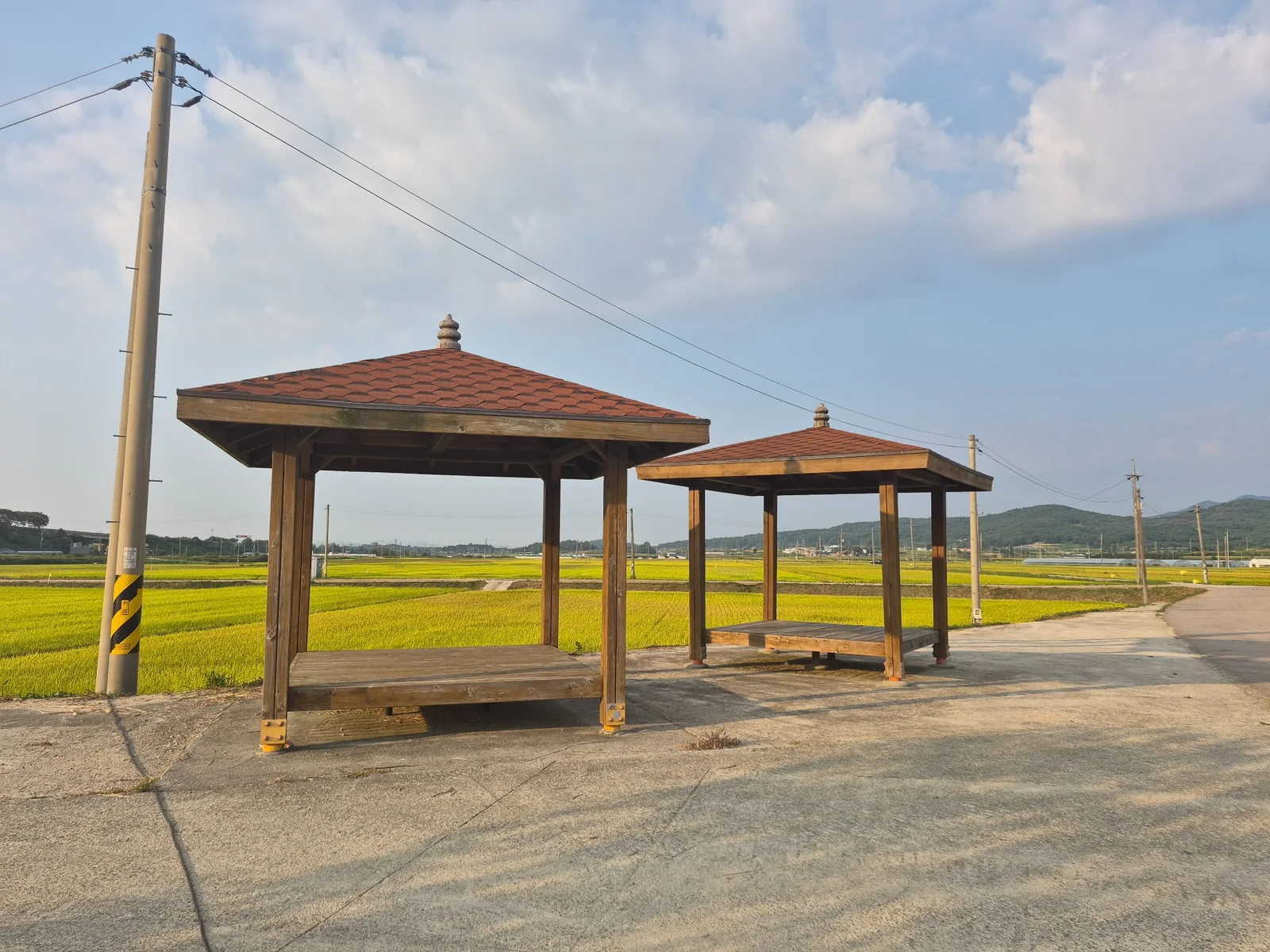
Drive along a small road through the Korean countryside and you may notice something that seems slightly unusual.
In the middle of wide rice fields, beside a narrow farm road, there may be a small wooden pavilion with a roof but no walls.
Sometimes there is only one. In other places, two may stand side by side.
They are simple structures, but they are a familiar part of some rural landscapes in Korea.
These small pavilions are commonly called jeongja (정자) in Korean. In places like this, however, they are less about sightseeing and more about something very practical: having somewhere to sit, rest, and escape the sun.
A Place to Rest Beside the Fields
Farming means spending long periods outdoors.
During Korea’s warmer months, working around rice fields can mean hours under strong sunlight and high temperatures.
A roofed pavilion creates something that can be surprisingly valuable in an open agricultural landscape: shade.
Farmers can stop working for a while, sit down, drink water, eat something, or simply cool down before returning to the fields.
This is not just an assumption based on the photographs. Local-government records in Korea show examples of agricultural rest areas being considered specifically because farmers working around large fields needed places to avoid the hot summer sun.
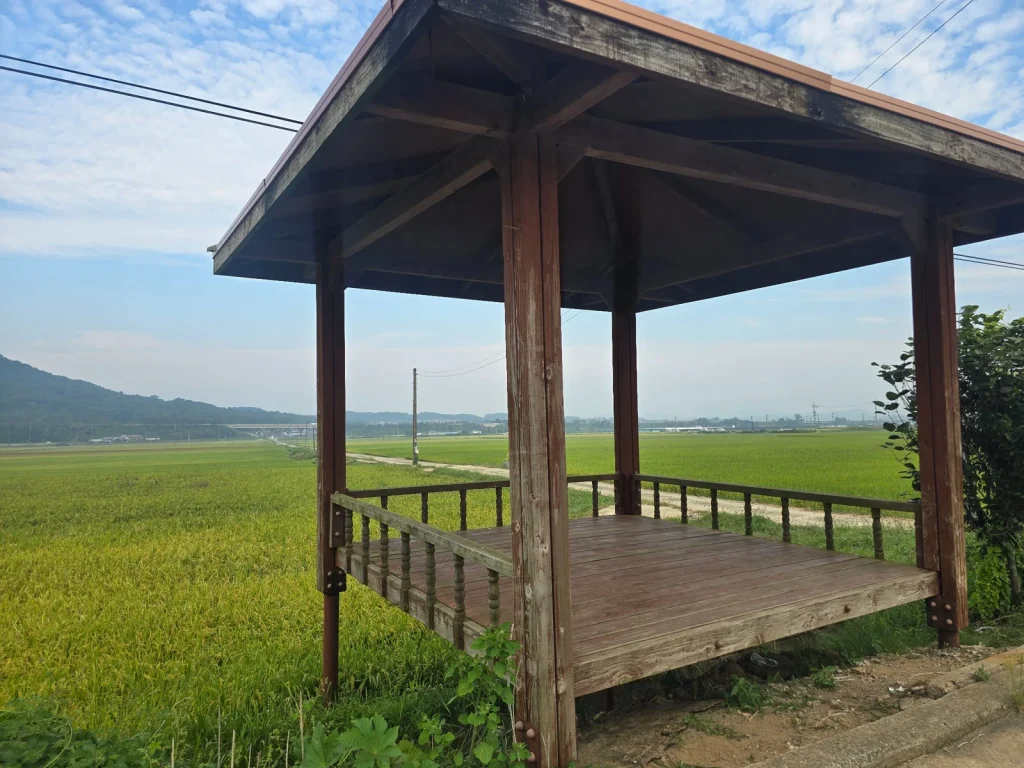
The pavilion in this photograph sits immediately beside the rice fields.
There are no walls to block the view or the breeze. From inside, you can look directly across the fields, farm roads, utility poles, distant hills, and the changing color of the rice.
It is a very simple structure, but its location makes sense.
Is Every Jeongja a Traditional Korean Pavilion?
This is where an important distinction is useful.
The Korean word jeongja can also refer to the beautiful traditional pavilions found at historic sites, gardens, mountains, and scenic places.
Some of those structures have architectural, historical, or cultural significance.
The pavilions in these photographs are much simpler.
They should not automatically be described as historic Korean architecture simply because people may call them jeongja. They are better understood as modern rural rest shelters built in a pavilion-like form.
Their value is practical rather than monumental.
You can sit down.
You have a roof over your head.
And you can rest without going far from the surrounding fields.
More Than a Resting Place for One Farmer
These structures can also serve a wider community purpose.
Public records from Korean local governments describe village pavilions and shelters as places intended to provide residents with comfortable resting spaces. Public data from Geumsan County, for example, describes many local pavilions as rest areas or community spaces.
That helps explain why some rural locations have more than one pavilion.
They are not necessarily private structures belonging to a single farm.
Depending on the location, they can be places where people working nearby sit together, neighbors stop for a conversation, or residents simply take a break.
Of course, not every pavilion in rural Korea has exactly the same purpose or owner. Without information about a particular structure, it would be wrong to assume who built it or exactly how it is managed.
But the general idea is easy to understand.
It is a shared place to stop.
Why Put a Pavilion in the Middle of Rice Fields?
At first, the location may look strange.
There are no shops nearby.
There may be no houses immediately beside it.
There might be nothing around except rice fields and a narrow road.
But that is precisely why a shelter can be useful there.
In a town, you can step inside a building when you want to rest. In an open agricultural area, there may be very little shade.
A small roof changes that.
It creates a place where someone can stop without having to travel back home or leave the farming area.
And because the sides are open, the pavilion remains connected to the landscape around it.
The View Changes With the Farming Season
There is another interesting thing about sitting in a pavilion like this.
The building may stay the same, but the scenery around it does not.
Rice fields change dramatically throughout the year.
During the growing season, they can be intensely green. As harvest approaches, the fields gradually turn yellow and gold. After harvest, the same landscape becomes open and brown.
So a very ordinary wooden pavilion can have a completely different view depending on when you visit.
In these photographs, the rice is already beginning to turn golden.
It is a sign that the countryside is moving toward harvest season.
A Small Part of Everyday Rural Korea
These pavilions are unlikely to appear on a list of famous Korean attractions.
Most travelers would probably drive past without stopping.
But that is exactly why they are interesting.
They were not placed beside the fields primarily to become tourist photo spots. They belong to the everyday landscape of rural life.
A roof.
A wooden floor.
A little shade.
And rice fields stretching out in every direction.
It is a very simple combination, but it reveals something about rural Korea that is easy to miss when traveling only through major cities.
Sometimes understanding a place begins with noticing the small structures that local people actually use.