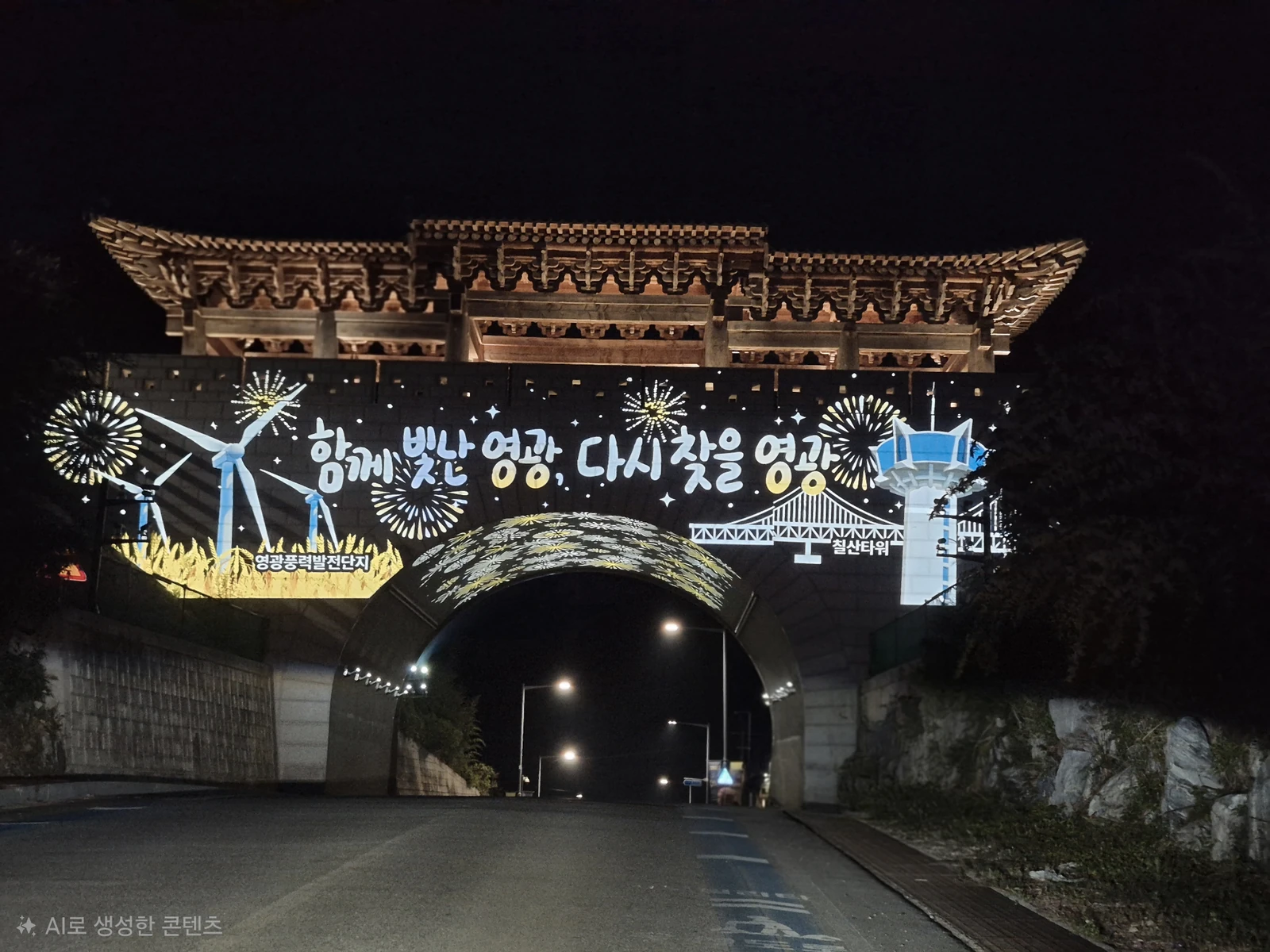
Sometimes, an ordinary drive through a small Korean town reveals something unexpected.
One evening, I was passing through Yeonggwang-eup in Jeollanam-do when I came across this large traditional-style gateway.
At night, it is difficult to miss.
The wooden structure is illuminated above the road, while cars simply drive underneath it on their way into and out of town.
Its name is Uidu Gate (의두문, 依斗門).
At first glance, it looks as though it might be an old gate that has stood here for hundreds of years.
But the story is a little different.
Is Uidu Gate an Old Korean City Gate?
The structure we see today is modern.
Uidu Gate was created as part of the Yeonggwang North Gate landscape improvement project at Bukmunjae, one of the entrances to Yeonggwang-eup.
The project included the construction of a traditional Korean-style gateway with a pavilion structure and a tiled hip-and-gable roof.
Therefore, the Uidu Gate we see today is not an old city gate that has survived unchanged for hundreds of years.
What makes it particularly interesting, however, is its name.
Why Is It Called Uidu Gate?
When Yeonggwang County was deciding what to call the new gateway, several possible names were considered.
A public preference survey actually favored the straightforward name “Yeonggwang North Gate.”
However, another idea emerged during the naming process.
According to the Yeonggwang-eupji, a historical record of the area, the old northern gate of Yeonggwang was called Uidu Gate (依斗門).
A committee that included local cultural representatives therefore decided to bring the historical name back, and Uidu Gate was selected as the name of the new gateway in 2022.
This distinction is important.
Today’s Uidu Gate is a modern structure, but its name connects it to an older part of Yeonggwang’s history.
A Gateway You Actually Drive Through
One thing I find interesting about Uidu Gate is that it is not separated from everyday life.
It stands directly over a road.
You do not necessarily have to make a special trip to see it. If you enter or leave Yeonggwang along this road, you simply drive beneath it.
During the day, it looks like a traditional Korean architectural feature marking the entrance to town.
At night, however, it feels quite different.
Lights illuminate the wooden roof and the large decorative panels below it, making the gateway stand out against the dark hillside.
The short video gives a better sense of what the gate is actually like.
It is not just something to stand in front of and photograph.
It is part of the road and part of the everyday landscape of the town.
Why Build a Traditional Gateway Here?
Bukmunjae is one of the approaches to central Yeonggwang.
Yeonggwang County sought to improve the area’s symbolic identity and surrounding landscape by installing a traditional Korean-style gateway and improving the nearby road environment, creating a landmark that would help shape visitors’ first impression of Yeonggwang.
There is something particularly interesting about that combination.
The structure itself is new, but its architectural style is traditional.
The road beneath it is completely modern, but the name above it comes from a historical record.
Old and new are not completely separated here.
They occupy the same space.
A Small Detail of Rural Korea
Uidu Gate is probably not a place that most international visitors to Korea have heard of.
It is not one of Seoul’s famous palace gates, and it would be misleading to describe the present structure as an ancient monument.
But that is exactly why I wanted to show it.
Places like this reveal another side of Korea.
Small towns are constantly changing, but they also find ways to bring pieces of local history into the present.
In Yeonggwang, one example is a modern gateway carrying the old name Uidu Gate.
For the people who live here, however, it can also be something much simpler.
It is part of the road home.