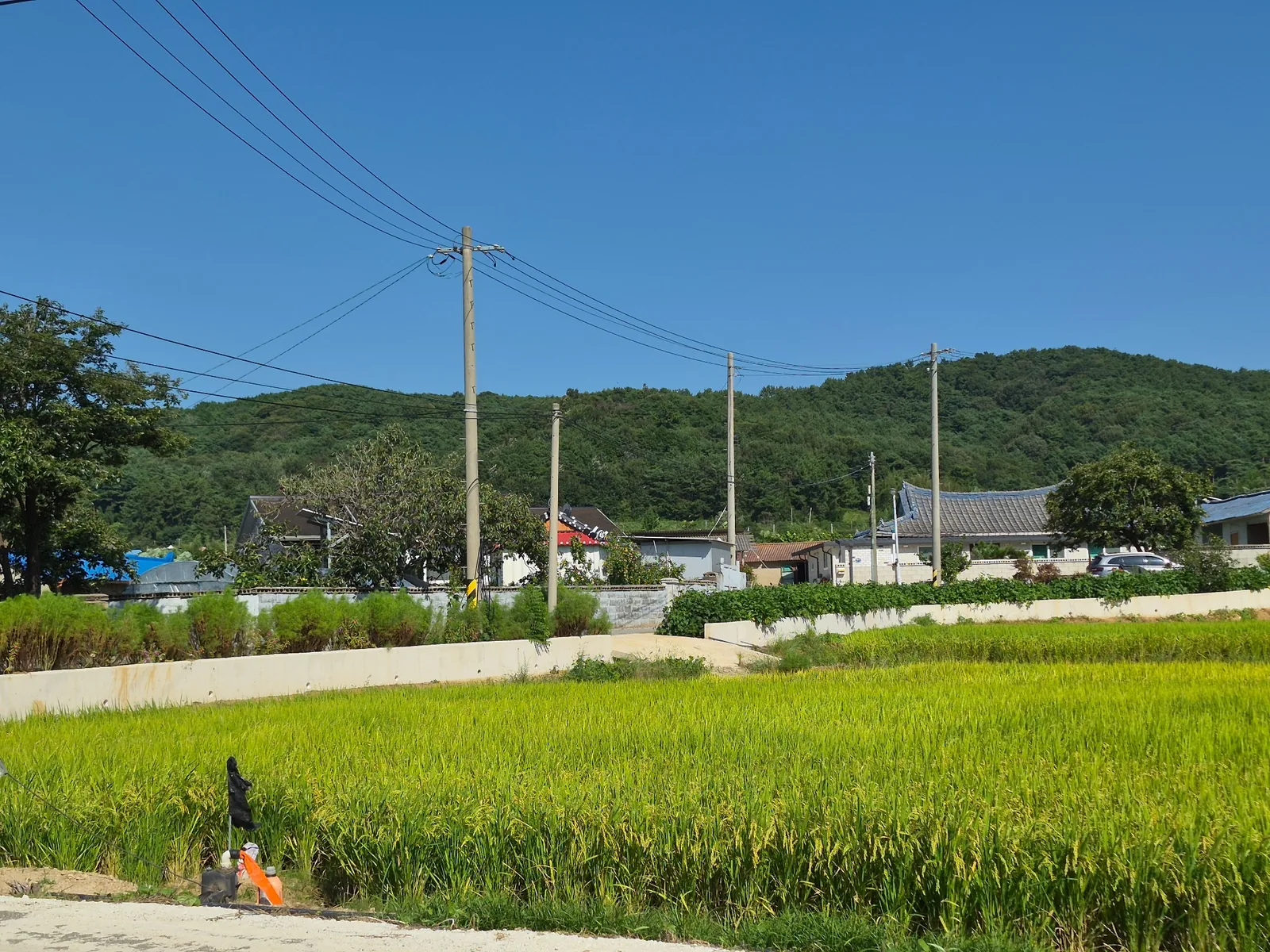
When people outside Korea imagine a traditional Korean house, they often think of a beautiful hanok with a tiled roof, wooden doors, and a peaceful courtyard.
Those houses certainly exist.
But if you actually travel through rural Korea today, you will see something much more diverse.
Old single-story homes stand next to renovated houses. Traditional tiled roofs can appear beside modern buildings. Small gardens, rice fields, apartments, and narrow roads can all exist within the same rural community.
I live in Yeonggwang, Jeollanam-do, and the houses around here show how much rural Korea has changed over the years.
Korean rural houses today are not simply traditional homes from the past. They are a mixture of old and new.
Korean rural houses beside rice fields in Yeonggwang, South Korea
Not Every Rural House Is a Hanok
Traditional Korean houses are known as hanok.
Hanok are famous for their wooden structures, tiled roofs, and traditional design. They are an important part of Korean architecture and history.
However, most people living in the Korean countryside today do not necessarily live in traditional hanok.
You can find many different kinds of homes.
Some are old single-story houses built decades ago. Others are brick houses, concrete homes, renovated farmhouses, or newly built country houses.
This is an important difference between the image of rural Korea seen in tourism advertisements and the places where people actually live.
Old Houses Are Still Common
Older houses are still easy to find in many Korean rural areas.
Some have tiled roofs, while others have metal or other types of roofing that have been repaired or replaced over the years.
The buildings may be small compared with modern homes, and many were built at a time when rural families lived very differently from today.
Some have been renovated with modern windows, kitchens, bathrooms, heating systems, and insulation.
Others remain much closer to their original condition.
Because rural populations are aging in many areas, you can also occasionally see houses that are no longer occupied.
Some Rural Houses Have Unique Uses
Not every old house in rural Korea is simply a family home.
Some buildings are used as small businesses, workshops, storage spaces, or places connected with traditional religious practices.
For example, this small house in Yeonggwang is used by a mudang, a Korean shaman.
Mudang are practitioners of Korean shamanic traditions, which have existed in Korea for a very long time.
Places associated with these traditions may sometimes have distinctive signs, flags, or other symbols outside.
It is an interesting example of how an ordinary-looking building in a Korean town can have a very different purpose.
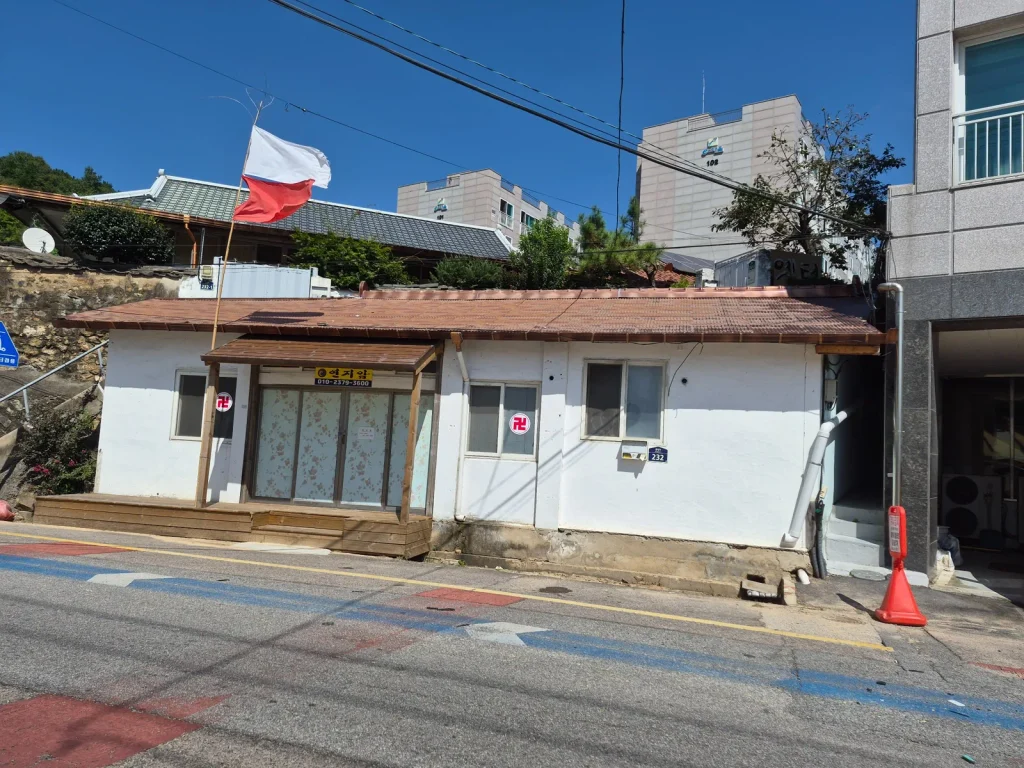
A small house used by a Korean shaman in Yeonggwang, South Korea.
House used by a Korean shaman in Yeonggwang South Korea
Old and New Exist Side by Side
One of the interesting things about Korean rural towns is how quickly the scenery can change.
An old single-story house may stand only a short distance from a modern apartment building.
A traditional tiled roof might be visible beside a newly constructed house.
This means that rural Korea does not always look like a perfectly preserved traditional village.
Instead, buildings from several different generations often exist together.
That mixture is one of the most realistic characteristics of Korean rural communities today.
Gardens Are Part of Many Rural Homes
Another common feature of rural houses is the space around them.
Many homes have small yards or gardens.
Residents may grow peppers, garlic, onions, lettuce, sesame leaves, fruit trees, or other seasonal crops.
For some families, these gardens are simply a hobby.
For others, growing food has been part of everyday life for decades.
It is common for vegetables grown at home to be eaten by the family or shared with relatives and neighbors.
This connection between the home and food production is something that is much easier to see in rural Korea than in large cities.
Rural Korea Does Not Always Mean an Isolated Village
Another common misunderstanding is that rural Korea consists only of tiny villages surrounded by rice fields.
That is not always true.
Rural counties usually have a central town where people go for shopping, restaurants, hospitals, banks, schools, government services, and other everyday needs.
In these areas, detached houses, older buildings, small businesses, apartments, and newer buildings can all be located close together.
The scenery can look surprisingly urban even though rice fields and small villages may be only a few minutes away.
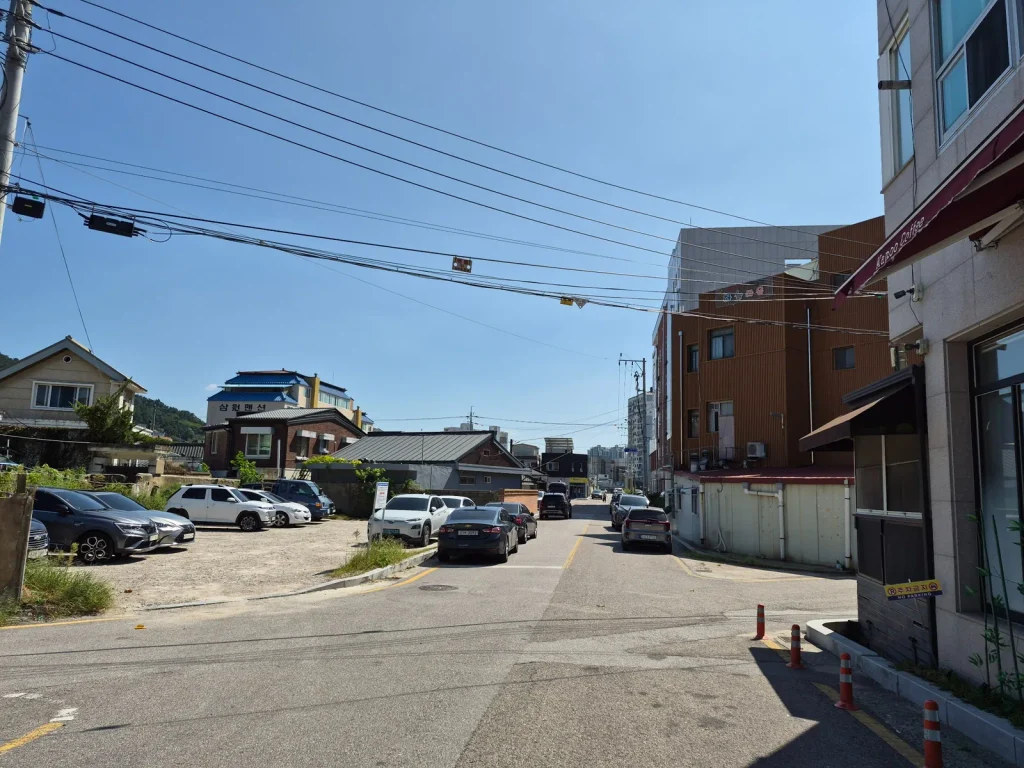
A residential street in Yeonggwang, showing the more urban side of a rural Korean county.
Residential street in Yeonggwang rural county South Korea
Apartments Exist in Rural Korea Too
Apartments are strongly associated with Korean cities, but they are not limited to Seoul, Busan, or other large urban areas.
Apartment buildings can also be found in smaller towns and rural counties.
For some residents, apartments are more convenient than older detached houses because they require less exterior maintenance and provide easier access to services.
This creates an interesting landscape.
You may see rice fields and farmhouses in one direction and apartment buildings in another.
That contrast is a normal part of modern rural Korea.
Rural Houses Require Work
Living in a detached rural house can offer more space than living in an apartment.
But more space also means more work.
Homeowners may need to maintain the yard, repair roofs or walls, remove weeds, manage drainage, and prepare the house for hot summers and cold winters.
Older homes can require even more maintenance.
So the idea of moving to the countryside and living a completely relaxed life is not always realistic.
A rural home can provide freedom and space, but it also brings responsibilities.
Korean Rural Houses Are Changing
The appearance of rural housing continues to change.
Some older homes are being renovated, while new country houses are being built.
At the same time, some homes become vacant as older residents pass away or move elsewhere.
This means a single village can contain an old traditional-style house, a renovated home, a modern detached house, and an empty building.
The countryside is constantly changing rather than remaining frozen in the past.
The Real Homes of Rural Korea
If you search for Korean houses online, you may see many beautiful hanok.
They are an important part of Korean culture and absolutely worth seeing.
But they are only one part of the story.
The real residential landscape of rural Korea includes old houses, modern homes, gardens, apartments, small businesses, rice fields, and buildings with unusual local uses.
These places may not always look like tourist attractions.
But they show how people actually live.
Final Thoughts
Korean rural houses reflect the changes that have taken place in the country over many decades.
Traditional architecture still exists, but modern lifestyles have changed the way people build, renovate, and use their homes.
In places like Yeonggwang, you can see old and new Korea standing almost side by side.
And sometimes, an ordinary-looking house has a story that you would never discover from a tourist guide.
That is another side of Korea beyond the big cities.