When people imagine rural Korea, they often picture rice fields, mountains, traditional markets, and quiet villages.
Those images are real. But they are only one part of life outside Korea’s big cities.
Drive from a small farming village into the center of a county town, and the scenery can change quickly. There are supermarkets, restaurants, convenience stores, banks—and increasingly familiar franchise cafes.
Yeonggwang, in Jeollanam-do, is a good example.
The county is surrounded by farmland and small rural communities. But in downtown Yeonggwang-eup, you can walk into a national coffee chain, order a drink from a touchscreen kiosk, pay electronically, and enjoy the same kind of cafe culture found throughout modern Korea.
For this visit, I stopped at a Mega MGC Coffee in town.
A National Coffee Chain in a Rural County
Mega MGC Coffee is one of Korea’s large coffee franchises.
The brand began in 2015 and expanded rapidly across the country. By 2026, it had passed 4,000 locations nationwide.
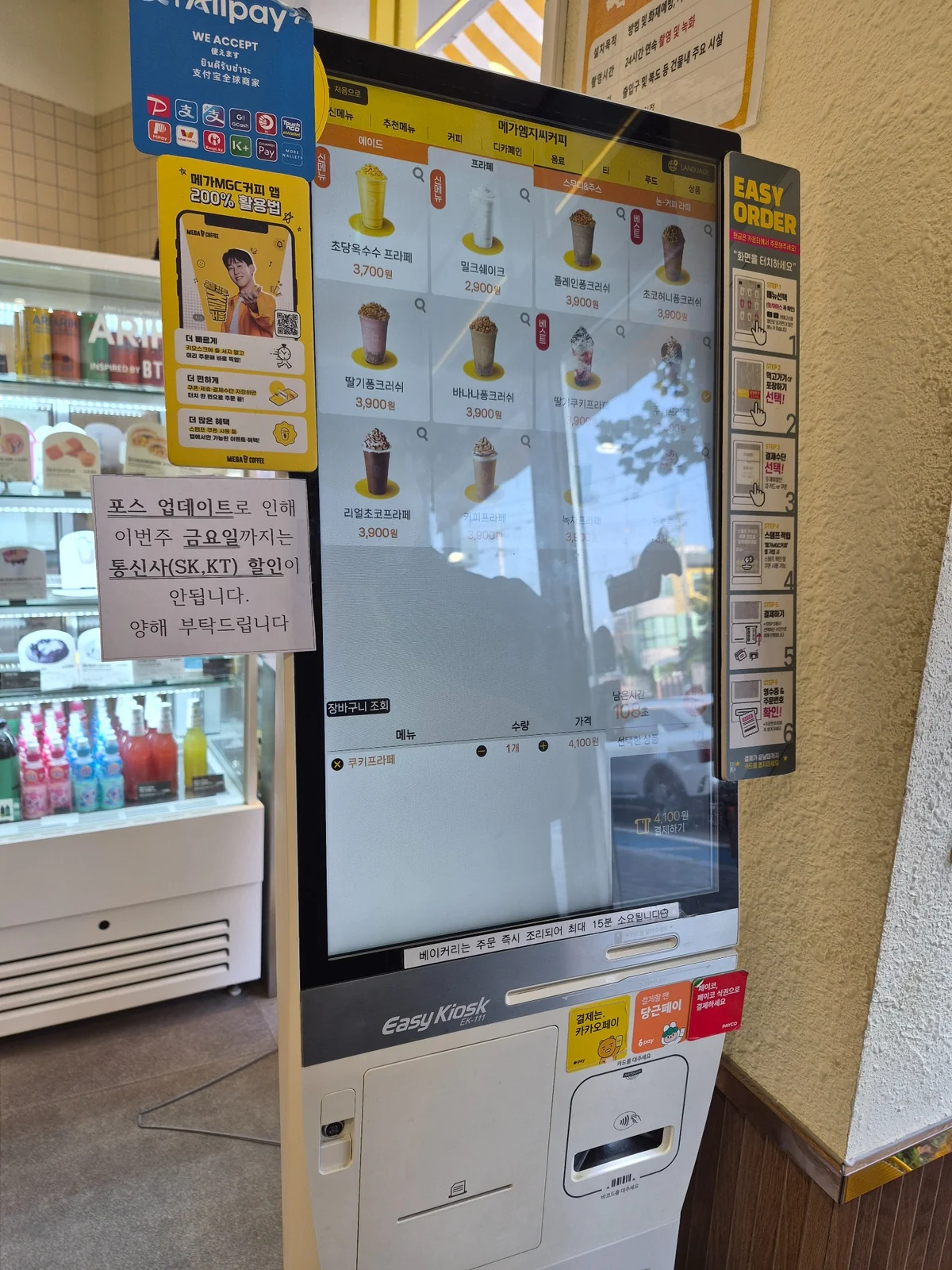
The company markets itself around large drinks and relatively affordable prices, which is also visible in the menu photographed at this Yeonggwang location.
But what interested me was not simply the brand.
It was where I was seeing it.
This was not central Seoul, Busan, or another major Korean city. I was in Yeonggwang-eup, the main town of a largely rural county in Jeollanam-do.
That distinction is useful when trying to understand life in rural Korea.
A small farming village and the nearby eup town center are different environments, but people move between them as part of everyday life. The town center is where many services, shops and restaurants are concentrated.
And today, franchise cafes are part of that landscape too.
Ordering Coffee Without Talking to Anyone
One of the first things you notice inside is the touchscreen kiosk.
Customers can browse drinks on the screen, select options and pay at the machine.
Mega MGC Coffee’s own current ordering information distinguishes between app orders and orders made in stores through kiosks or POS systems, showing how self-service ordering has become integrated into the chain’s normal operations.
For someone visiting Korea for the first time, this can feel surprisingly modern if their image of rural Korea comes mainly from photographs of rice fields and old villages.
The kiosk in the photograph displays dozens of colorful drinks. Payment logos and other digital services surround the screen.
You can be in a county surrounded by rice fields and still order a drink from a large touchscreen.
Those two versions of Korea are not contradictions.
They exist side by side.
Cafe Culture Is Not Only for Young People
Another thing I regularly notice around Yeonggwang is that cafe culture is not limited to teenagers or young adults.
Older residents enjoy cafes too.
When people from surrounding rural areas come into town to eat, it is common to see older customers visit a cafe after their meal.
And they are not necessarily coming in just for a traditional cup of coffee.
Sweet drinks, lattes and other cafe beverages can be part of the experience.
For some groups, the cafe becomes the next place to sit together after lunch or dinner—to talk for a while longer before going home.
This is one of those small details of everyday Korean life that can be difficult to notice from tourism guides.
The cafe is not necessarily a destination by itself.
It can simply be the second stop after a meal in town.
But Kiosks Can Still Be Difficult for Older Customers
There is another side to Korea’s rapid adoption of digital ordering.
Not everyone finds a touchscreen kiosk convenient.
For some older customers, navigating multiple menus, choosing options and completing payment on a screen can be confusing or uncomfortable.
That is worth mentioning because seeing kiosks everywhere does not necessarily mean that everyone has adapted to them equally.
In a staffed cafe, however, customers who have difficulty with the machine can generally ask an employee for assistance.
So the scene can be an interesting mixture of generations and technology: older rural residents enjoying modern cafe culture while sometimes still preferring help from a person when it comes time to place an order.
The technology may be new.
The social habit of sitting together, talking and sharing something to eat or drink is much older.
More Than Just Coffee
Modern Korean coffee chains sell considerably more than basic coffee.
Mega MGC Coffee describes itself as offering coffee alongside a wide range of beverages, and its current menu includes seasonal drinks and bakery items as well.
Inside the Yeonggwang store, there was also a display of branded merchandise and character products.
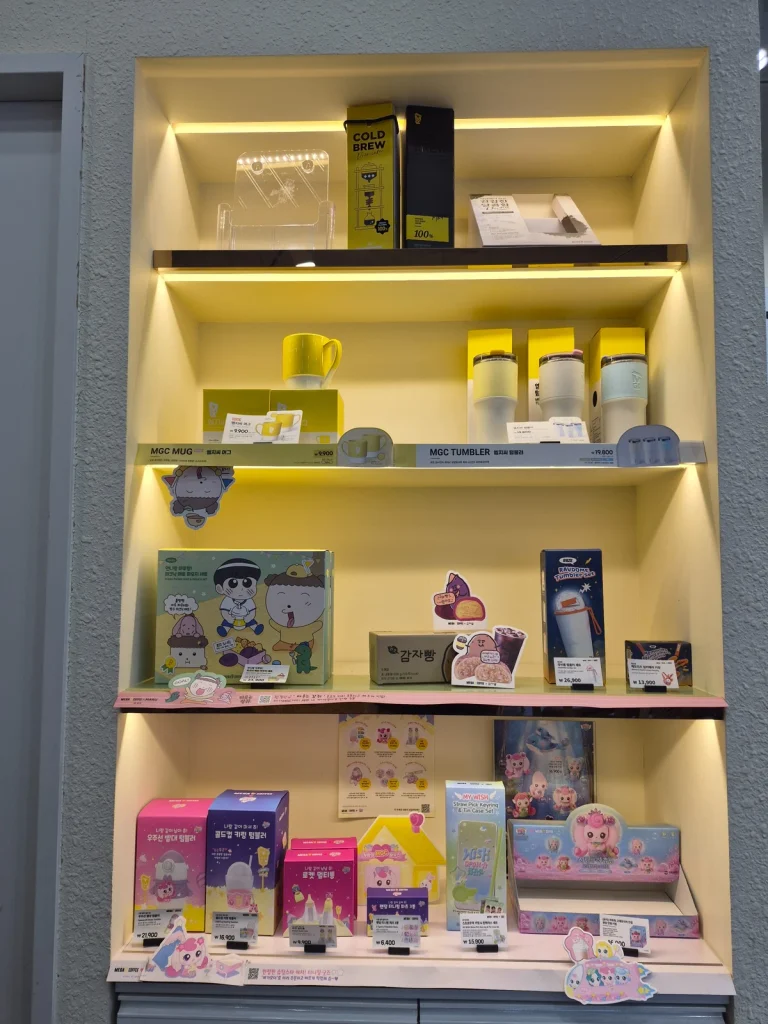
This is another example of how Korean franchise cafes have developed into more than places to buy an Americano.
Drinks, desserts, seasonal menus, character collaborations and merchandise can all become part of the experience.
And that culture does not stop at the boundary of Seoul.
The Same Yellow Sign Reaches Small Towns Too
Mega MGC Coffee’s bright yellow branding is difficult to miss.
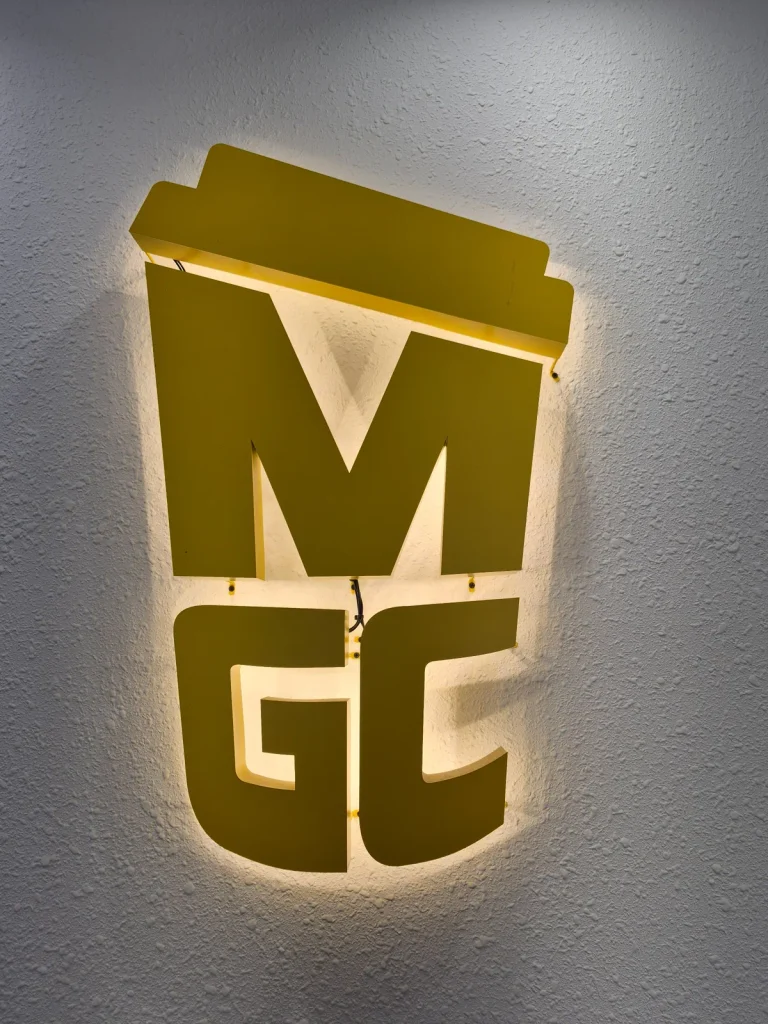
A nationwide brand appearing in a small county town may seem completely ordinary to Koreans.
In many ways, it is.
But for someone trying to understand modern rural Korea, that ordinariness is exactly what makes it interesting.
Life outside Seoul is sometimes presented as though there are two separate Koreas: a modern, digital Korea in the cities and a traditional Korea in the countryside.
Real life is much less tidy.
Rural Korea Is Modern Too
Leave downtown Yeonggwang and it does not take long before the landscape changes again.
Rice fields, farm roads and small villages return.
That is the Korea I have shown in many of the photographs on this site.
But living in a rural area does not mean being disconnected from contemporary Korean life.
People drive into town for shopping or a meal. They visit cafes. They use cards and digital payments. They encounter touchscreen kiosks. Older residents sit together over sweet drinks just as younger customers do.
Sometimes they need a little help with the technology.
Sometimes they do not.
That combination is part of what rural Korea actually looks like today.
The rice fields are real.
The old villages are real.
And so is the franchise cafe with a touchscreen kiosk in the middle of a small Korean town.