South Korea has four distinct seasons, and each one changes the landscape in a different way.
Spring brings warmer weather and new growth. Summer turns the countryside deep green under hot and humid conditions. Winter can be cold and dry, leaving fields quiet until another farming season begins.
But in rural Korea, autumn feels different.
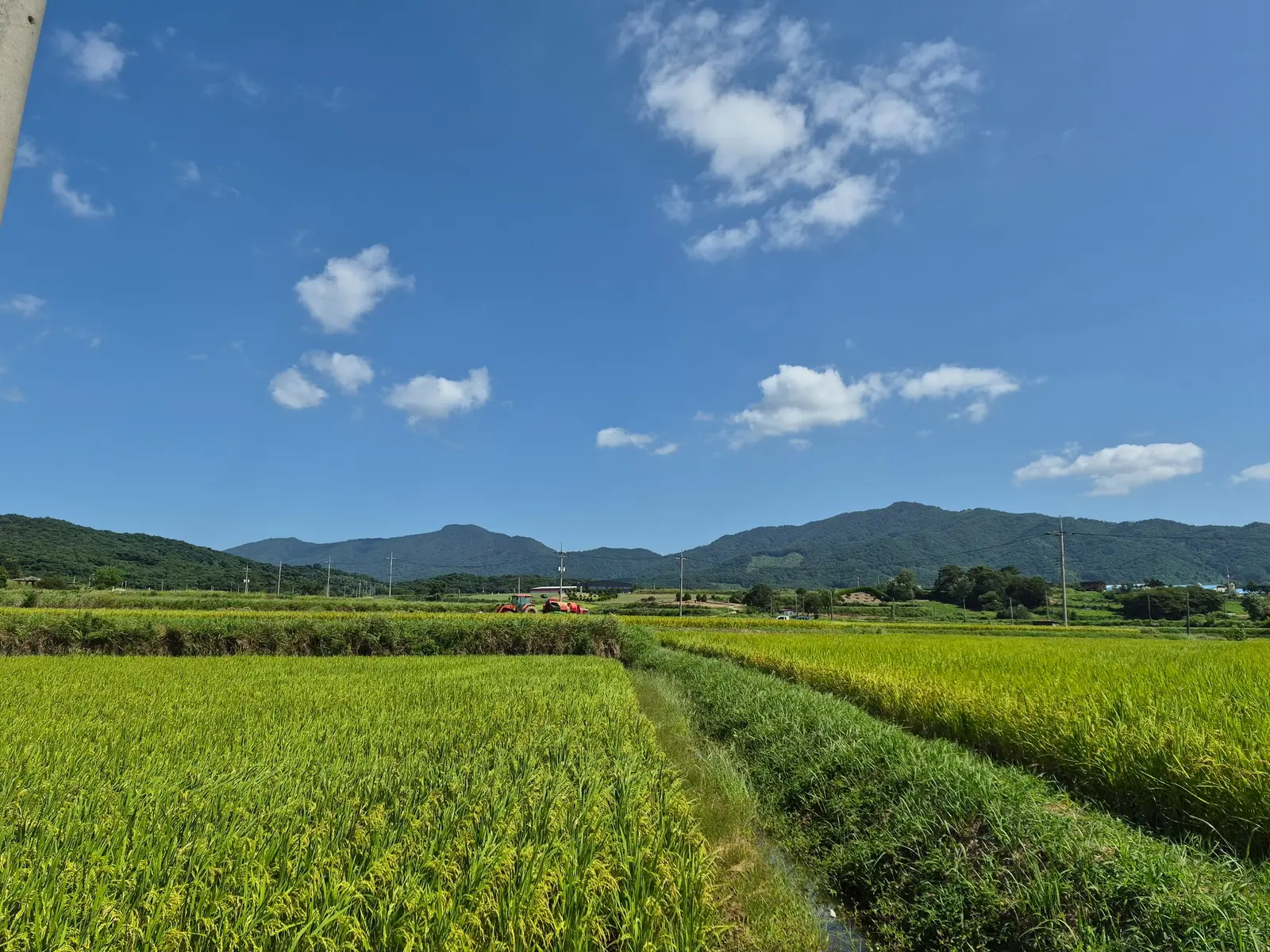
This is when rice fields begin to change from green to yellow and gold. The heavy rice heads bend toward the ground, harvest approaches, and farmers become increasingly busy.
For many people, autumn means cool weather and colorful leaves.
For farmers, it also means that months of work are finally approaching harvest.
Four Seasons, Four Different Countrysides
Korea’s four seasons are easy to recognize, but in farming areas the differences can feel especially dramatic.
Spring is a season of preparation and new growth. Farmers prepare fields, and rice farming moves toward planting young rice seedlings in paddies.
By summer, rice fields have become thick and green. The plants grow rapidly through Korea’s hot, humid and rainy summer weather.
Then autumn arrives.
The temperature begins to fall, the air becomes more comfortable, and the appearance of the fields slowly changes.
Green rice plants gradually develop yellow and golden tones as the grain matures.
Eventually, winter follows. After the harvest, many rice paddies become quiet and brown, creating a completely different landscape from the green fields of summer.
The land itself makes the changing seasons visible.
You Can See Autumn Arriving in the Rice Fields
In a city, people may first notice autumn when the temperature drops or leaves begin to change color.
In the countryside, you can see it happening across entire rice fields.
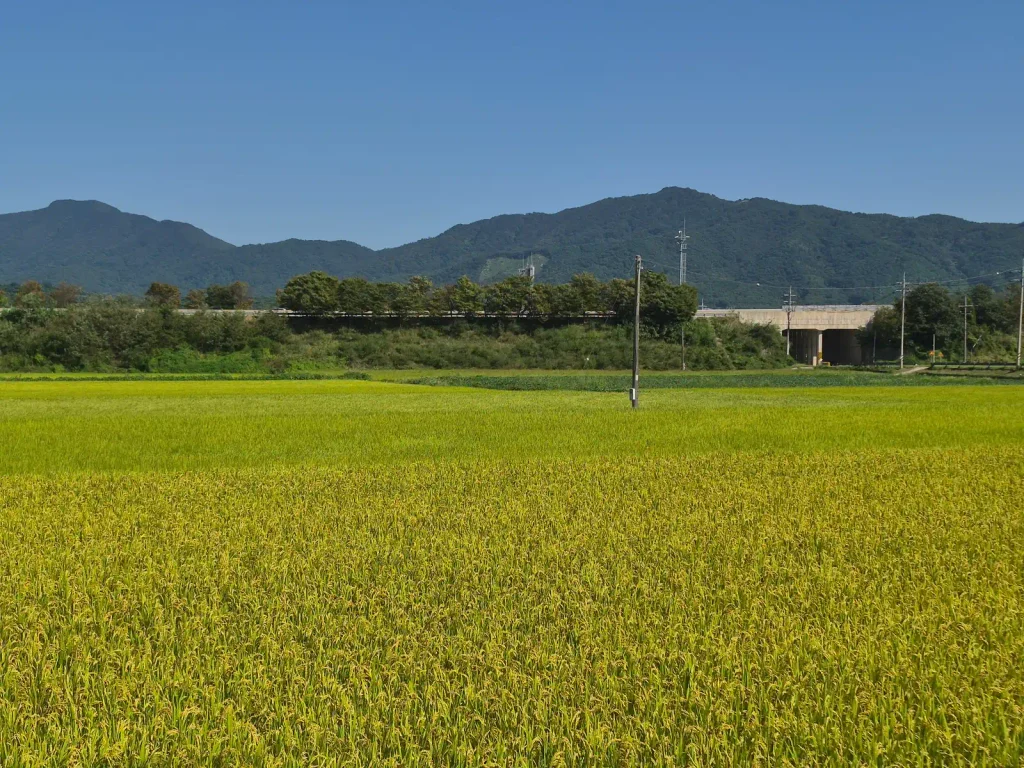
The rice does not suddenly change color in a single day.
Some fields remain relatively green while others nearby are already much more yellow. Different varieties, planting dates, local conditions and farming decisions can all affect when a field reaches harvest.
That creates a short period when the countryside becomes a patchwork of green, yellow and gold.
The photographs in this article were taken during that transition.
The rice is ripening, but not every field is ready to be harvested yet.
To me, this changing color is one of the clearest signs that autumn has arrived in rural Korea.
Rice Harvest Does Not Begin Everywhere at Once
Drive through a farming area during this period and another interesting pattern becomes visible.
One field may still be full of standing rice.
The field beside it may already have been harvested.
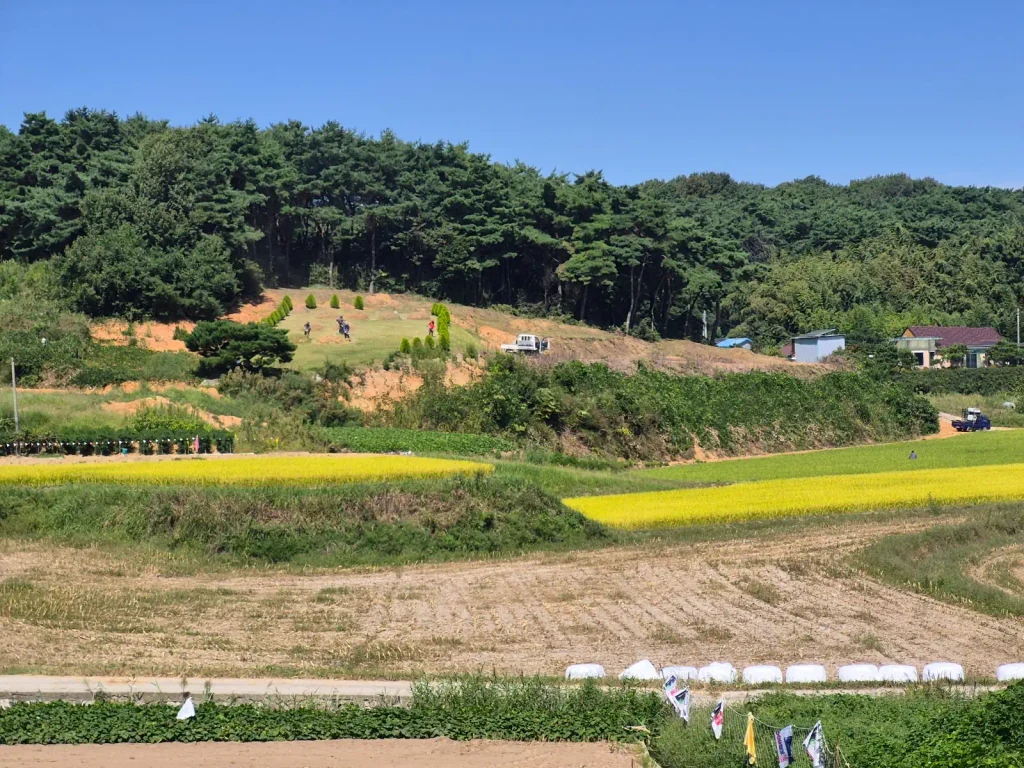
This photograph shows that contrast clearly.
Some land has already been harvested or cleared, while nearby rice fields are still yellow with ripening grain.
There is no single day when all of Korea suddenly begins harvesting rice.
Harvest timing varies with region, weather, rice variety, planting schedule and the condition of each field.
That is why an autumn drive through the Korean countryside can show several stages of the farming season within a surprisingly small area.
Autumn Is Beautiful, but Farmers Are Busy
From a distance, golden rice fields can look peaceful.
For the people working in them, however, harvest season is anything but quiet.
As crops reach the right stage, farmers have work to finish within limited windows. Machinery has to be prepared and moved, crops harvested, loads transported, fields managed, and other autumn farm work completed.
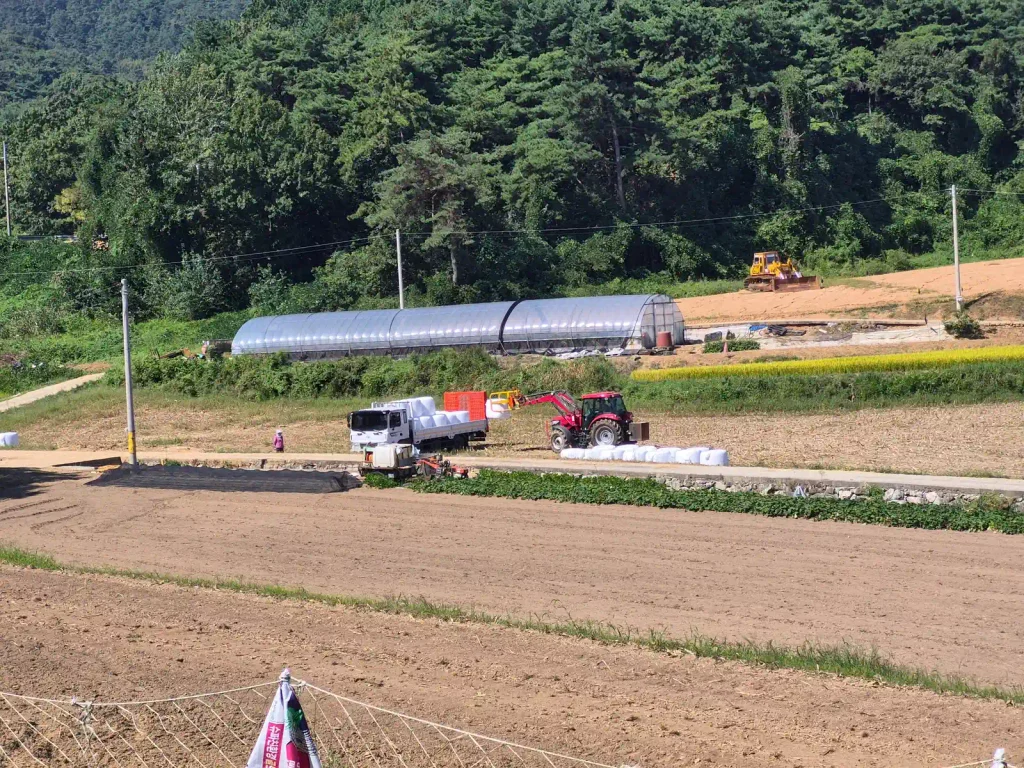
This is why I wanted to include this photograph even though it is not simply a beautiful landscape.
There is a tractor, a truck, cultivated land, a greenhouse and people working.
It shows another side of autumn in Korea.
The yellow rice fields may be what visitors notice first, but behind that scenery are people working through one of the busiest periods of the agricultural year.
Rice Is More Than Part of the Scenery
For someone visiting Korea, a wide golden rice field can simply be a beautiful place to photograph.
But rice has a much deeper connection to everyday Korean food and agricultural life.
A bowl of bap, or cooked rice, has traditionally occupied a central place in a Korean meal. Even the Korean word bap can carry a broader everyday association with having a meal.
That makes the rice fields more than seasonal scenery.
What grows in these fields eventually becomes part of an ordinary meal served on tables across the country.
When you look at a rice field just before harvest, you are looking at the agricultural beginning of one of the most familiar foods in Korea.
The Countryside Changes Quickly in Autumn
One reason I like watching the rice fields at this time of year is that the scenery does not stay the same for long.
First, there is a large green field.
Then yellow begins to spread across it.
Soon the rice becomes heavier and more golden.
And eventually a harvesting machine enters the field.
After the harvest, the golden landscape disappears almost as quickly as it appeared.
A field that was full of mature rice can become an open harvested field in a short time.
The seasons continue, and the countryside moves with them.
What Autumn Really Looks Like in Rural Korea
Autumn in Korea is often introduced through famous mountains covered with red and orange leaves.
Those landscapes are certainly beautiful.
But that is only one version of Korean autumn.
Come to a farming area and autumn can look like something else entirely.
It can be a narrow concrete road running between rice paddies.
It can be rice changing from green to gold beneath a blue sky.
It can be a tractor crossing a field.
It can be a truck waiting beside farmland.
And it can be farmers working while everyone else simply admires the scenery.
For me, this is another side of autumn in Korea that is worth seeing.
The rice fields turn golden for only a short time.
Then the harvest begins.
And in rural Korea, one season quietly gives way to the next.