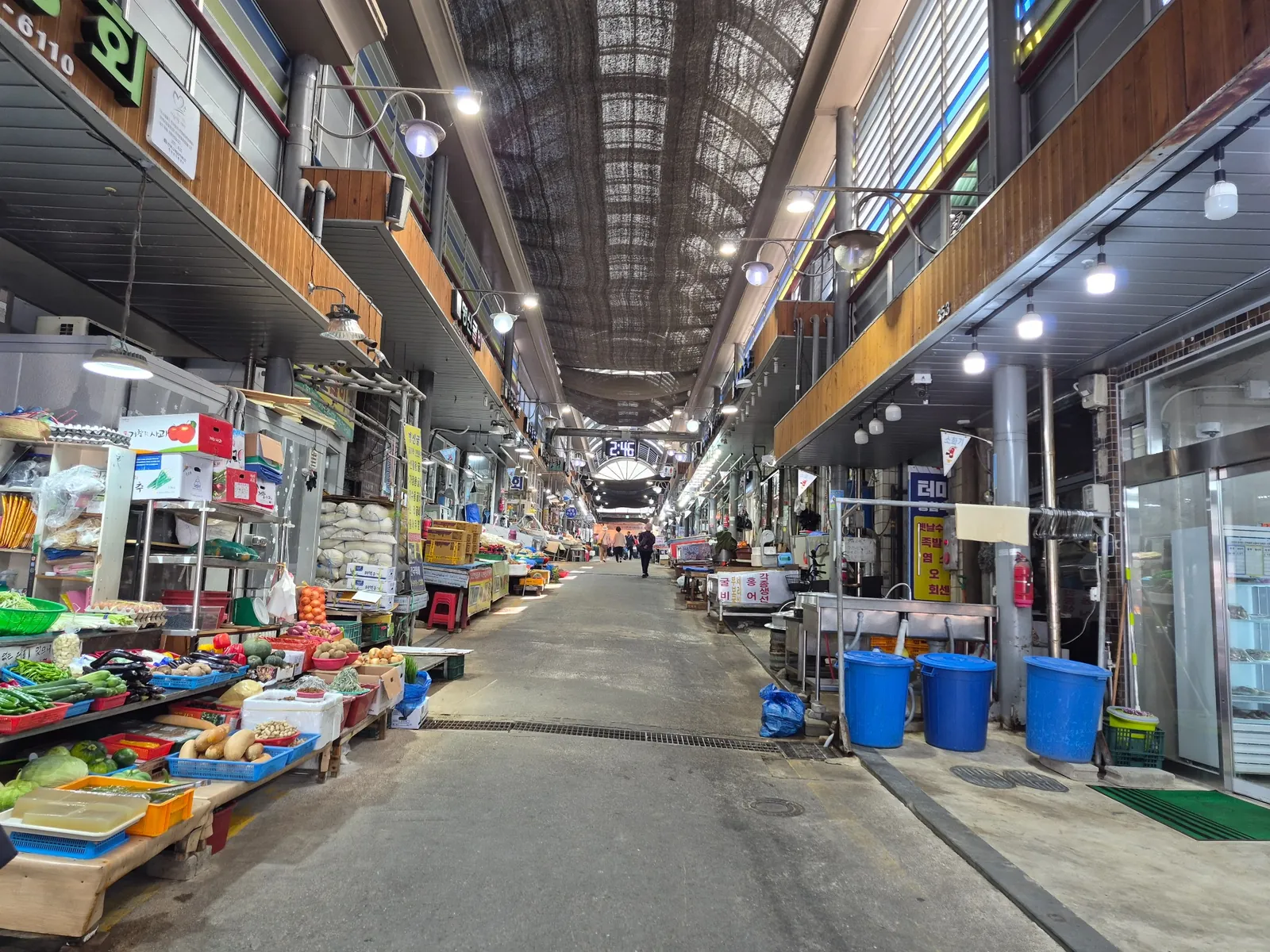
When people think of traditional markets in South Korea, they may imagine famous markets in Seoul filled with street food, tourists, and busy crowds.
But traditional markets are not only tourist attractions.
In smaller towns across Korea, markets are still part of everyday life.
I live in Yeonggwang, a rural county in Jeollanam-do in southwestern South Korea. The market here is not a place I discovered while traveling. It is part of the area where people around me actually live and shop.
That is what makes it interesting.
If you want to see a quieter and more ordinary side of Korea, a local market like this can tell you a lot about how people really live.
A Market for Local People
Yeonggwang is very different from Seoul.
There are farms, rice fields, fishing communities, small towns, and villages throughout the county. For people living in these areas, a traditional market has long been a place to buy food and other necessities.
Walking through the market, you will not find the polished displays of a modern shopping mall.
Instead, vegetables may be stacked in baskets, seafood is displayed in simple containers, and small stores line narrow covered walkways.
It can look a little messy.
But that is also part of its character.
This is not a market designed to look traditional.
It is simply a market that people still use.
Seafood Is a Big Part of the Market
One of the first things you notice in the market is seafood.
At different stalls, you can see fish, squid, shellfish, and other seafood displayed in boxes and containers.
For someone visiting Korea for the first time, the way seafood is sold in a local market may look quite different from a supermarket.
There is less packaging.
You can see the food directly in front of you, and customers can talk to the seller about what they want to buy.
Markets like this also show how closely Korean food is connected to the sea.
Even in a small rural county, seafood is an important part of everyday cooking.
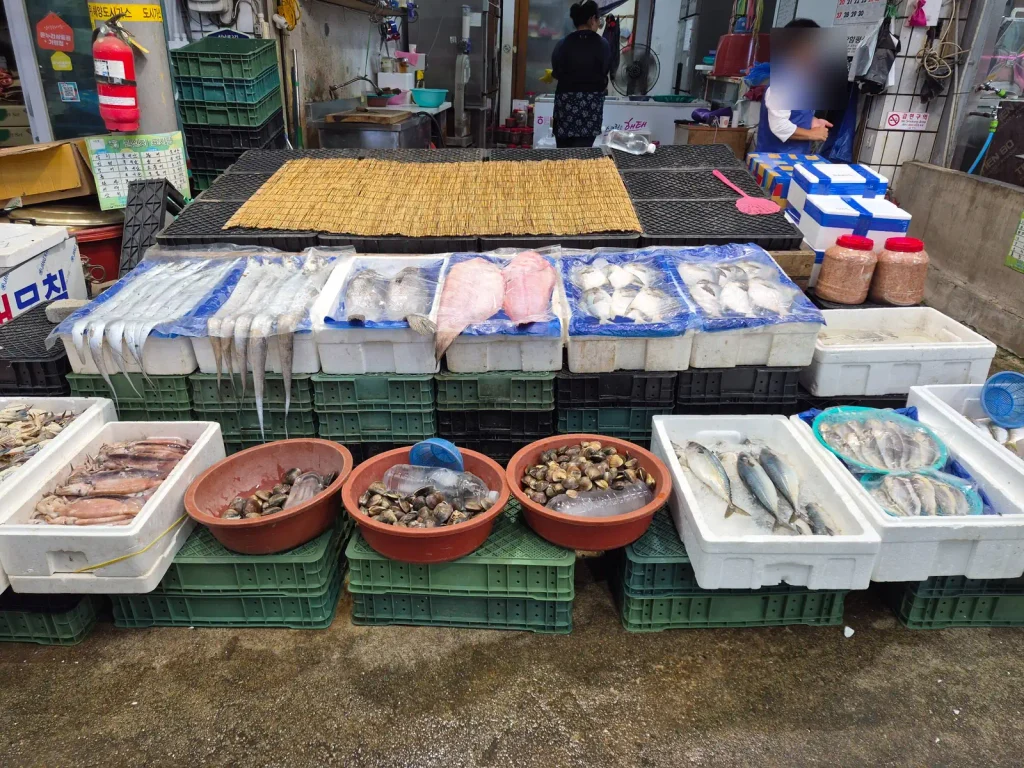
Fresh fish and shellfish for sale at a traditional market in Yeonggwang, South Korea.
Salted Seafood Is Part of Korean Food Culture
Another common sight in Korean traditional markets is jeotgal, or salted and fermented seafood.
At the market, you may see large jars filled with different types of salted seafood alongside bottles and containers of fish sauce.
To someone unfamiliar with Korean cooking, these may be less recognizable than kimchi or Korean barbecue.
But they are an important part of Korean food culture.
Fish sauce and salted seafood are used in many Korean dishes, especially when making kimchi and other traditional foods.
Seeing them sold in a local market gives you a glimpse of Korean food before it reaches the restaurant table.
It is not just about what Koreans eat.
It is also about the ingredients people buy to make that food at home.
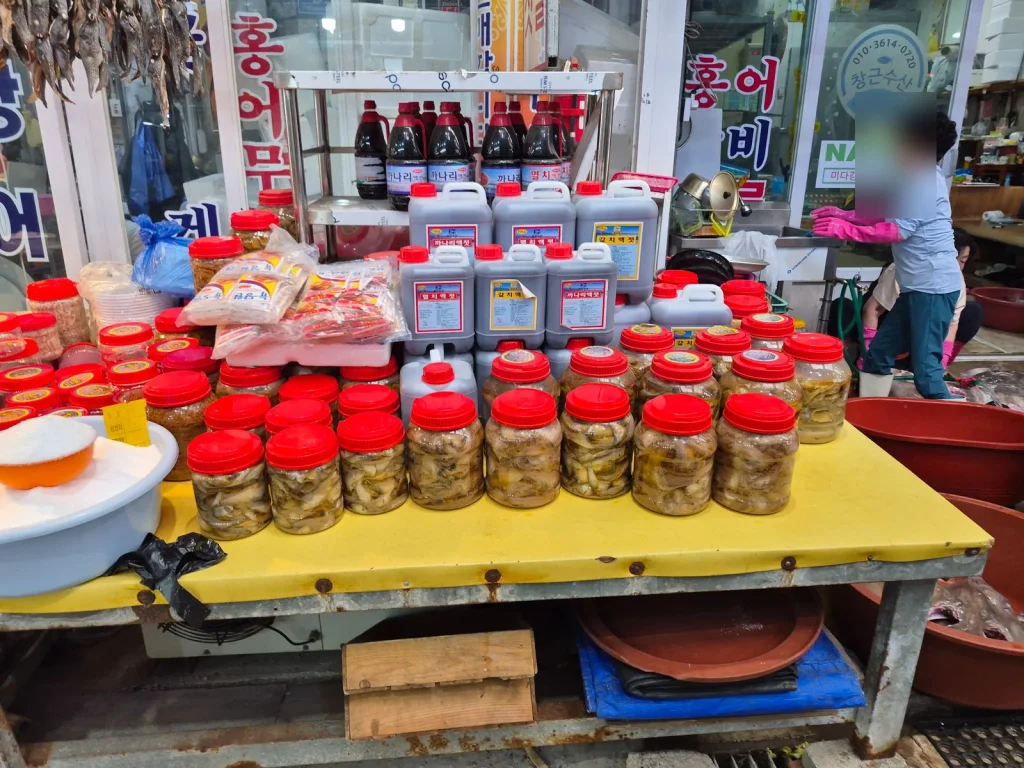
Salted seafood and fish sauce displayed at a local market in Yeonggwang.
Dried Seafood Is Everywhere
Dried seafood is another familiar part of Korean markets.
Anchovies, shrimp, and other small seafood can be dried and stored for use in everyday cooking.
Dried anchovies are especially common in Korean kitchens. They are often used to make broth for soups, stews, and noodle dishes.
What looks like a simple bowl of dried fish can therefore be the beginning of many different Korean meals.
This is one of the things I like about traditional markets.
You can see ingredients in a much more direct way.
Instead of everything being sealed inside identical packages, different foods are displayed in bowls, trays, boxes, and baskets.
The market feels connected to cooking.
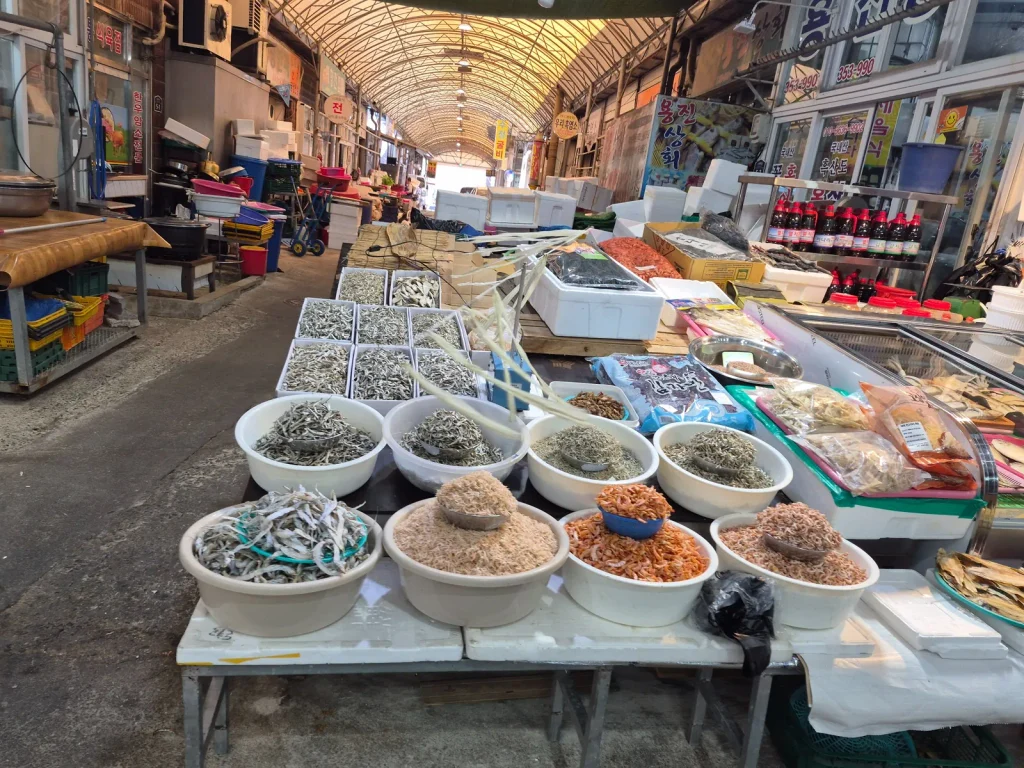
Dried anchovies, shrimp, and other seafood displayed at a market stall in Yeonggwang.
Market Days Feel Different
One interesting part of traditional market culture in Korea is the five-day market, known as an oiljang (오일장).
In Yeonggwang, market days fall on dates ending in 1 and 6 — for example, the 1st, 6th, 11th, 16th, 21st, and 26th of the month.
On these days, the area becomes noticeably busier.
More sellers come in, more goods are available, and people from surrounding rural areas visit the market.
On an ordinary day, parts of the market can feel surprisingly quiet.
But on market day, the atmosphere changes.
This difference between an ordinary day and a five-day market day is something that is difficult to understand from photographs alone.
You have to see the people arriving, hear the conversations between sellers and customers, and walk through the market yourself.
This Is Not a Tourist Market
Perhaps the most interesting thing about Yeonggwang Market is what it is not.
It is not a market built primarily for tourists.
Most people are not walking around taking photographs or searching for famous street food.
They are buying fish.
They are choosing vegetables.
They are buying ingredients for meals at home.
Sellers are working, customers are shopping, and people stop to talk to someone they know.
It is ordinary.
And that ordinary quality is exactly what makes places like this interesting to me.
Many visitors come to Korea looking for something “authentic.”
Sometimes authenticity is not a hidden restaurant or a secret tourist destination.
Sometimes it is simply a place where local people are going about their normal day.
Traditional Markets Are Changing Too
Of course, rural markets in Korea are changing.
Supermarkets, online shopping, delivery services, and large retail stores have changed the way people buy food and household goods.
Younger generations do not necessarily shop at traditional markets in the same way their parents or grandparents did.
Yet markets like this continue to exist.
They are part of the history of local towns, but they are also still part of the present.
That combination is important.
Rural Korea is not frozen in the past.
Old ways of shopping and modern ways of living exist side by side.
Why Visit a Local Korean Market?
If you travel outside Korea’s major cities, I think a local market is worth visiting.
You do not necessarily need to buy anything.
Just walk slowly.
Look at the vegetables, fish, dried seafood, and ingredients you may never have seen before.
Listen to people talking.
Notice how sellers arrange their products and how local customers shop.
A traditional market can show you something that famous attractions sometimes cannot:
ordinary Korean life.
Final Thoughts
Yeonggwang Market may never be as famous as the large traditional markets of Seoul.
That is not necessarily a disadvantage.
For me, places like this are part of the Korea that often disappears from travel guides.
They are practical, imperfect, sometimes quiet, sometimes busy, and deeply connected to the people who live nearby.
If you want to understand rural Korea, do not look only at mountains, rice fields, and old houses.
Walk through a local market too.
You may learn just as much about Korea from a bowl of dried anchovies as you do from a famous tourist attraction.