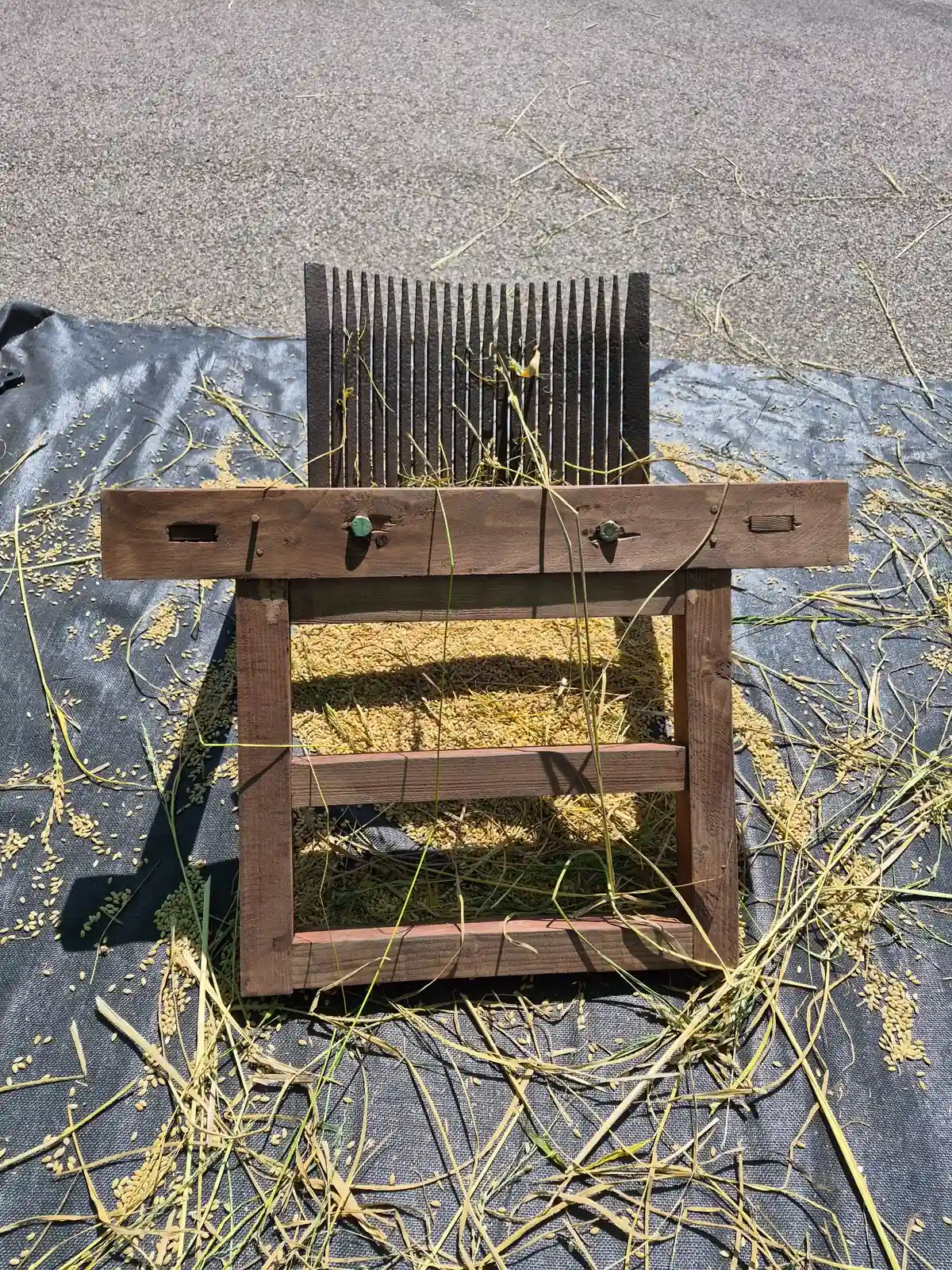
Today, harvesting rice in South Korea is largely a job for machines.
A modern combine can move through a rice field, cutting the rice and separating the grain as part of the harvesting process.
But before machines took over this work, separating rice grains from harvested stalks required much more manual labor.
One of the tools used for that job was the holtae (홀태).
At first glance, it does not look very complicated. It is essentially a wooden frame fitted with a row of closely spaced metal teeth.
But this simple agricultural tool tells an interesting story about how rice was once harvested in Korea.
What Is a Holtae?
A holtae is a tool used to separate rice grains from harvested rice stalks.
Its most distinctive feature is the row of long, narrow teeth that look a little like a large metal comb.
The basic method was simple.
A worker would hold a bundle of harvested rice, place the grain-bearing ends of the stalks between the metal teeth, and pull the stalks through them.
As the rice passed between the teeth, the grains were stripped from the stalks and fell below.
The Academy of Korean Studies describes this type of tool as an implement for stripping grain from harvested rice. The tool had numerous regional names, and holtae was a name used in Jeollanam-do.
Look Closely at the Photograph
The photograph makes the way the tool worked easier to understand.
The narrow metal teeth are still visible at the top. Around the wooden frame are rice stalks and loose grains that have fallen onto the ground.
Nothing is hidden inside a motor or complicated machine.
The work depended on the person using it.
Put the rice between the teeth, pull the stalks through, collect the grain, and repeat.
Again and again.
It is a remarkably simple process compared with modern rice harvesting.
Holtae, Geune and Different Regional Names
One interesting thing about old Korean agricultural tools is that the same or similar implements were not always called by the same name throughout the country.
Historical and regional sources use several names for rice-stripping tools of this type.
Geune (그네) is one of the best-known names, while holtae was used in Jeollanam-do. Other regional names also existed.
The National Folk Museum of Korea explains that the names geune and holtae have also been used together or interchangeably in discussions of these comb-like rice-stripping implements. It also notes that improved versions introduced during the Japanese colonial period became part of the changing history of Korean threshing tools.
For an old farming tool that looks so simple, its history is more complicated than it first appears.
This Was Only One Part of the Harvest
Using a holtae did not turn harvested rice directly into the white rice that appears in a bowl.
There were several stages between a rice field and food ready for the kitchen.
After rice was harvested, the grain had to be separated from the stalks. Other work was then needed to separate useful grain from straw, chaff and other material.
Koreans used a variety of agricultural tools for these jobs.
Traditional threshing methods included striking harvested grain against implements such as a gaesang (개상), while tools for winnowing helped separate heavier grain from lighter debris. Over time, these labor-intensive methods were replaced by increasingly mechanized threshing equipment.
The holtae therefore represents just one step in a much larger process that once required considerable time and physical work.
From Holtae to Threshing Machines
Agricultural technology did not change all at once.
Older threshing methods gradually gave way to improved rice-stripping tools and mechanical threshers.
Eventually, combines transformed the harvest even further.
The National Folk Museum of Korea describes this progression from traditional threshing implements to threshing machines and ultimately to combines.
That change dramatically altered what harvest season looked like.
Work that once required people to handle bundles of rice repeatedly could increasingly be performed mechanically in the field.
Today, seeing a holtae beside freshly harvested rice can therefore feel like looking at two different periods of Korean farming at once.
A Small Tool With a Big Story
When we look at a golden rice field today, it is easy to focus only on the beauty of the landscape.
But every grain of rice once required a great deal of human labor.
Tools such as the holtae remind us of that.
It is not a grand piece of architecture or a famous cultural treasure. It is a practical agricultural tool built to perform one repetitive job.
And that is precisely what makes it interesting.
Everyday objects like this show how ordinary people worked, how farming technology changed, and how the Korean countryside became what it is today.
A modern combine can finish work that once required many repeated movements by hand.
The old holtae sitting among rice stalks is a small reminder of just how much Korean farming has changed.