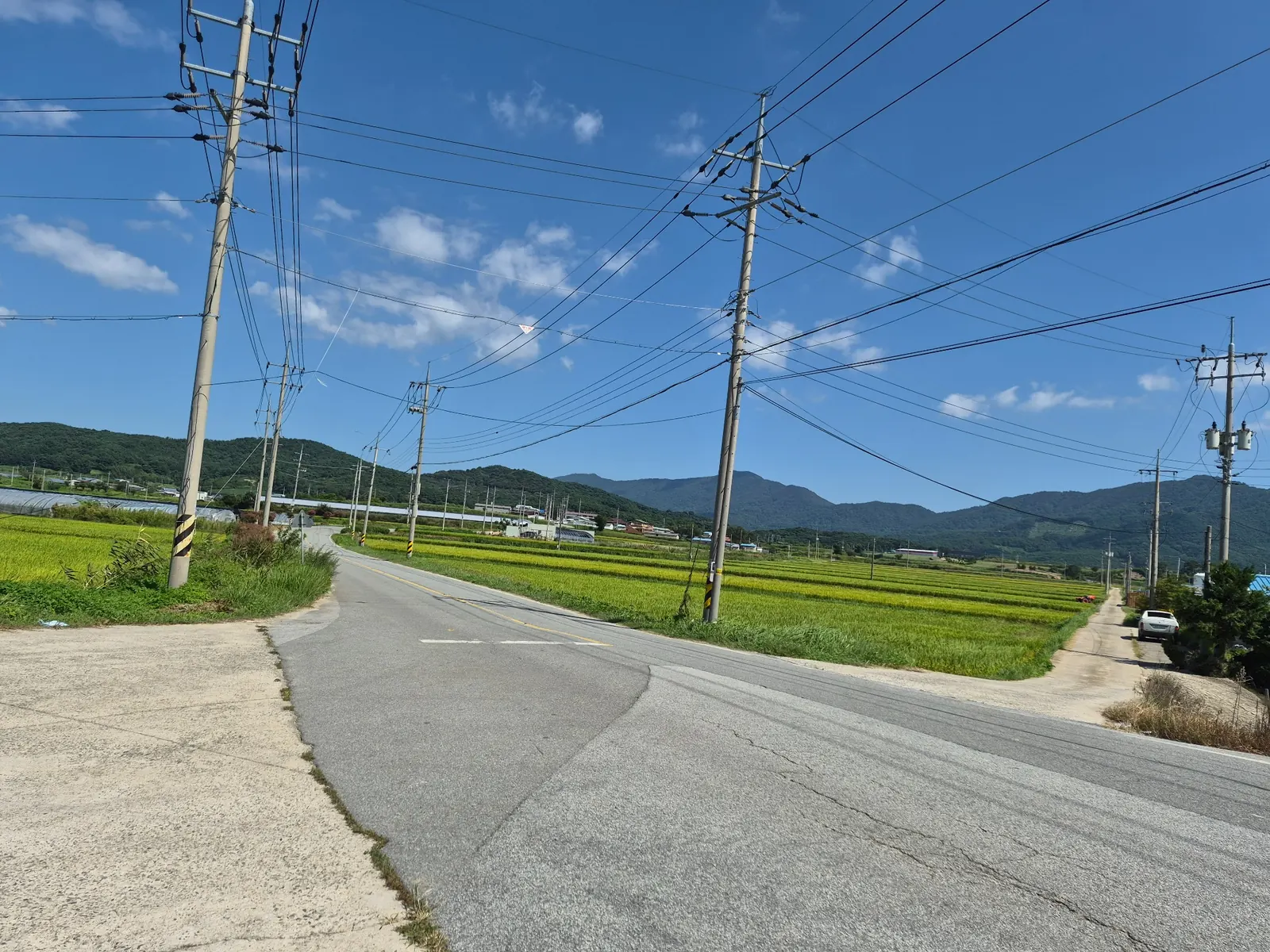
When people imagine the Korean countryside, they may picture rice fields, mountains, small villages, and narrow farm roads.
But there is something else that appears almost everywhere in this landscape: utility poles.
Drive through rural Korea and you will see concrete poles standing beside rice fields, following narrow roads, and continuing toward small villages in the distance.
For people who live here, they are so ordinary that we barely notice them.
But once I started photographing them, I began to see them differently.
These poles are not just part of the scenery.
They are also a visible sign of how electricity—and the wider infrastructure of modern life—reaches even small communities deep in the Korean countryside.
Part of the Rural Landscape
Utility poles are everywhere in the Korean countryside.
They follow roads between rice fields, continue toward clusters of houses, and cross farmland surrounded by mountains.
In some places, there may be little more than a narrow farm road, rice fields on both sides, and a row of utility poles disappearing into the distance.
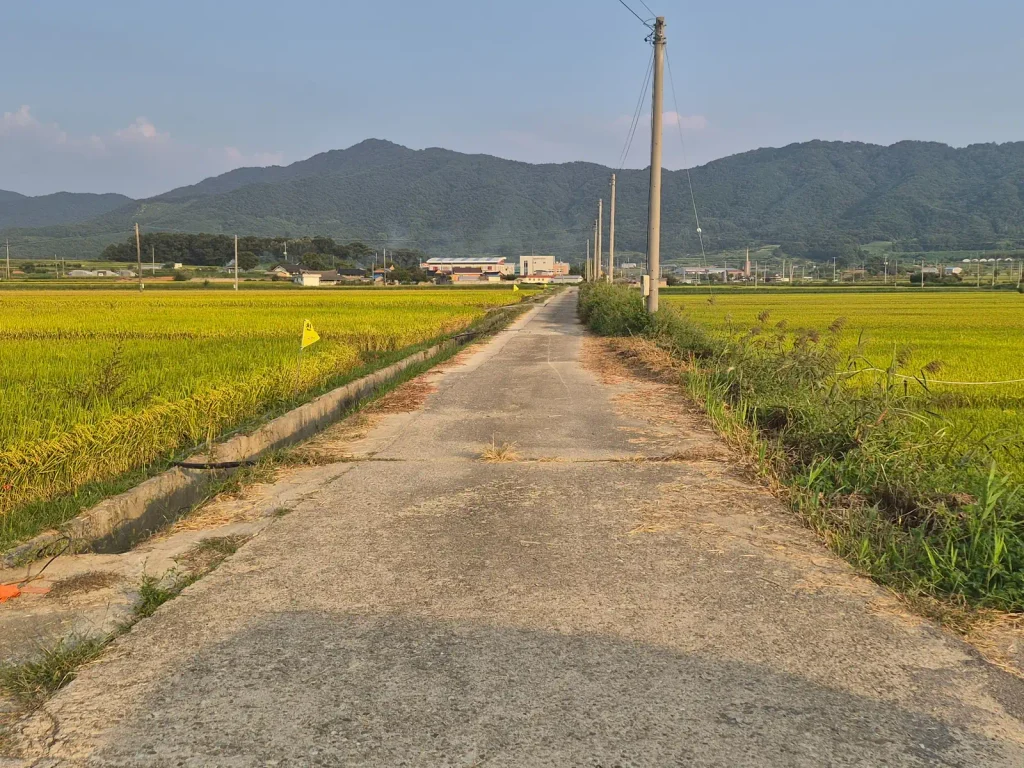
This is not the kind of scene that normally appears in a Korean tourism advertisement.
There is no palace, famous restaurant, or tourist attraction here.
It is simply what everyday rural Korea looks like.
And those ordinary concrete poles serve an important purpose.
More Than Just Concrete Poles
Not every utility pole looks the same.
Some carry relatively simple lines, while others have transformers, insulators, switches, and other electrical equipment attached to them.
One of the easiest things to recognize is a transformer. The cylindrical equipment mounted high on some poles is part of the system used to change voltage so electricity can be supplied where it is needed.
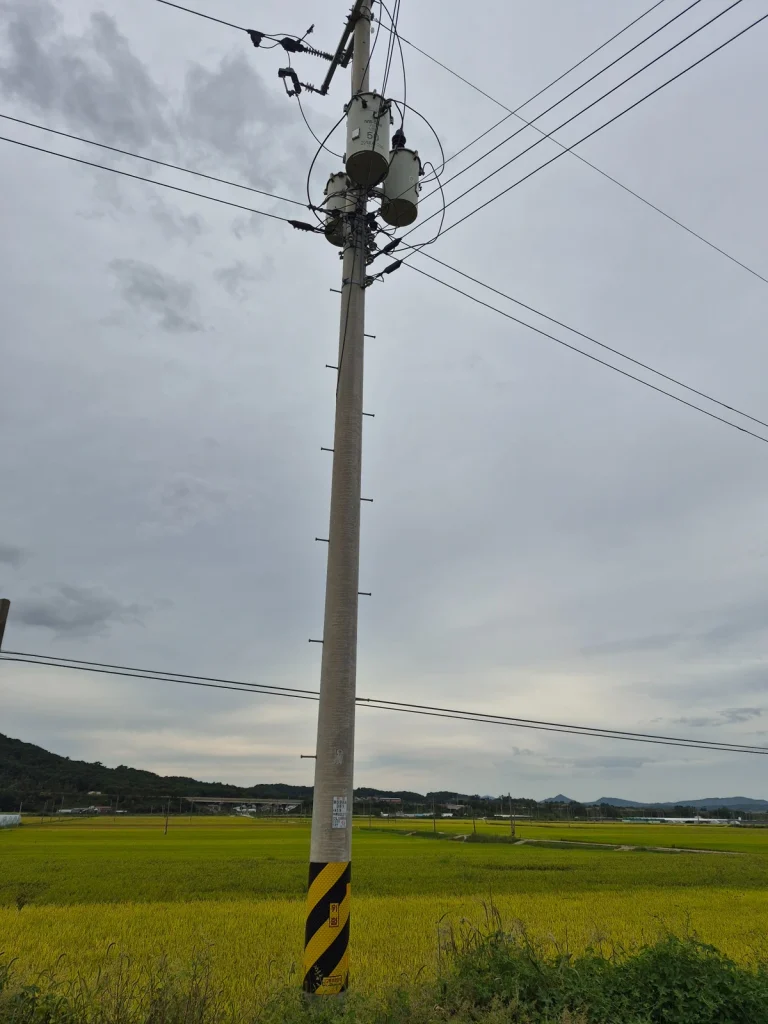
When you stand beneath one and look up, what seemed like a simple concrete pole suddenly looks much more complicated.
It is one small part of a huge network that brings electricity across the country.
KEPCO’s distribution network stretches across Korea, using both overhead and underground lines to deliver electricity to customers.
Connecting Even Small Rural Communities
This is the part of these photographs that interests me most.
Look at the road in the photos.
There are rice fields, mountains, narrow roads, and only a small number of buildings.
Yet the utility poles continue.
One leads to another, and then another, carrying infrastructure farther into the countryside.
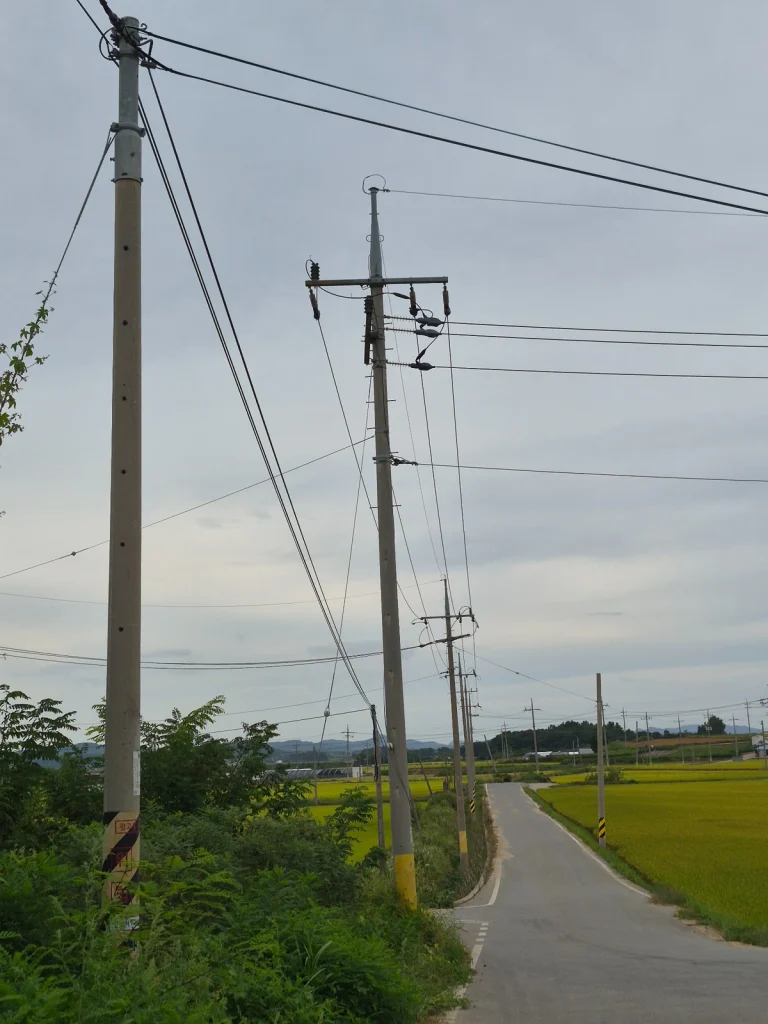
To me, these poles represent something more important than their appearance.
Even a small village surrounded by rice fields can be connected to the same modern infrastructure that people depend on in cities.
Electricity can reach homes, farms, greenhouses, workshops, and other buildings scattered across the countryside.
Telecommunications networks also extend into rural communities.
That does not mean every wire visible in these photographs is an internet cable. From a photograph alone, it would be wrong to identify each line as electricity, telephone, or internet infrastructure.
But the broader story is clear: living far from a large Korean city does not necessarily mean living disconnected from modern services.
Electricity—and the Internet—Beyond the Cities
The internet is particularly interesting.
South Korea has taken steps to make high-speed internet available beyond densely populated urban areas.
The Korea Telecommunications Operators Association states that its universal broadband service system is designed so users can receive 100 Mbps broadband service anywhere in the country. Where a building does not already receive 100 Mbps service, a designated provider can provide universal service upon application, although actual speeds can vary depending on the building and number of users.
That makes rural life in Korea different from the image some people may have of an isolated countryside.
A home surrounded by rice fields can still have electricity and high-speed internet.
A farmer can use online banking, order supplies, communicate with customers, watch streaming video, or use internet-connected equipment without living in a large city.
The scenery may be rural.
The connection to modern life does not have to be.
That is something I think about when I see a line of utility poles disappearing down a small road between the rice fields.
Why Are Utility Poles Disappearing From Some Cities?
The situation can look quite different in parts of Korean cities.
Some overhead electrical infrastructure has gradually been moved underground through undergrounding projects.
One of the reasons is appearance. Removing utility poles and overhead wires can create a cleaner streetscape and improve the pedestrian environment. KEPCO has also noted that demand for undergrounding has increased alongside interest in urban appearance, walking conditions, and safety.
There are practical differences as well.
Above-ground electrical equipment is constantly exposed to the natural environment. KEPCO lists lightning, heavy snow, heavy rain, falling or contacting trees, birds, and other external causes among potential sources of power outages.
Putting cables underground can protect them from some hazards affecting overhead equipment.
But undergrounding is not simply a matter of burying every wire.
Underground systems can be expensive to construct, and locating and repairing faults underground can take longer. KEPCO has described construction cost and maintenance considerations as important disadvantages compared with overhead lines.
That helps explain why Korea today has both kinds of infrastructure.
Most Distribution Lines Are Still Above Ground
Even though underground power lines may be increasingly noticeable in developed urban areas, overhead lines have certainly not disappeared from Korea.
According to KEPCO’s 2025 data, the nationwide undergrounding rate for distribution lines was 22.1 percent.
That means underground distribution is still a minority of the national network.
And in the countryside, overhead utility poles remain especially easy to see.
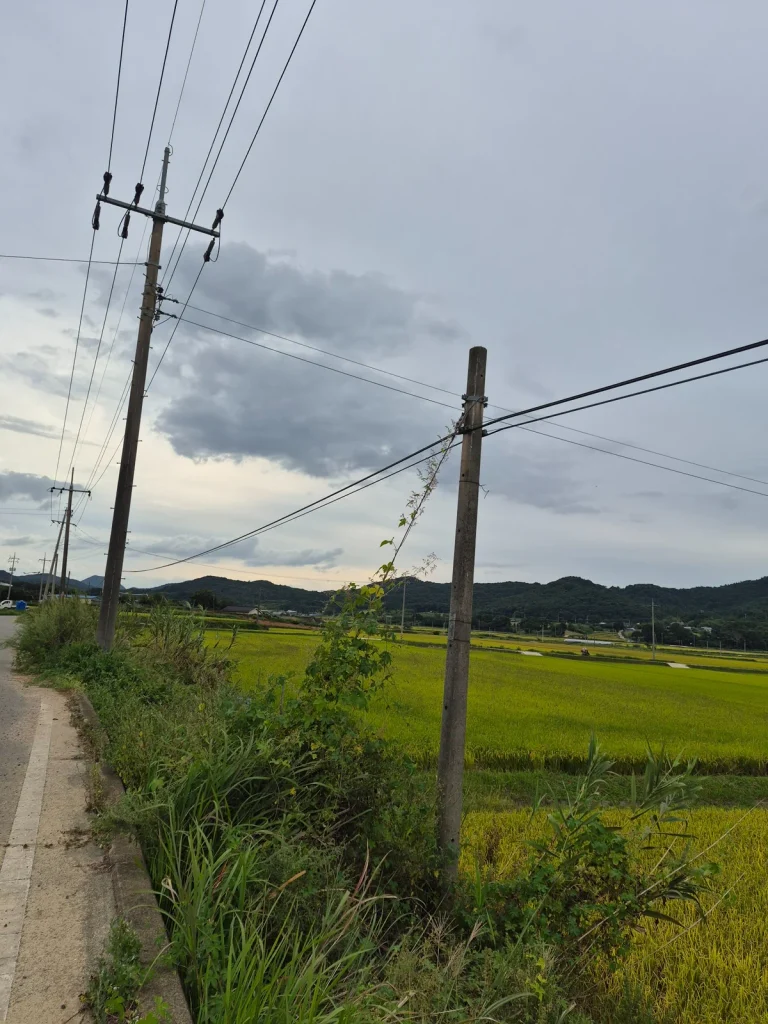
They stand beside farm roads, between fields, near houses, and along the roads connecting one small community to another.
They are not simply leftovers from an older Korea.
They are still working infrastructure.
Following the Roads Through the Rice Fields
There is also something visually interesting about utility poles in the countryside.
From a distance, they can reveal where a road goes.
One pole leads to another.
Then another.
When the road curves through the rice fields, the line of poles often follows it.
During the growing season, green rice stretches beneath them. As harvest approaches, those same fields gradually turn golden.
The concrete poles hardly change, but the landscape around them changes with the seasons.
This combination of utility poles, narrow roads, rice fields, mountains, and changing seasons is something I regularly see in rural Korea.
Something So Ordinary That We Stop Seeing It
Utility poles are not tourist attractions.
Most people living in Korea probably pass them every day without thinking about them.
I did too.
But photographing them made me realize that they tell a small story about rural Korea.
They show how a road between rice fields is connected to a much larger system.
Follow those poles far enough and they may lead toward a tiny group of houses or a small farming community.
Yet people living there can still turn on the lights, use appliances, connect to the internet, communicate with the outside world, and take part in modern everyday life.
Korea is often shown through palaces, skyscrapers, neon signs, cafés, and famous tourist destinations.
Those places are real.
But Korea is also a narrow road through rice fields with concrete utility poles standing beside it.
Perhaps more wires will eventually disappear underground.
For now, these poles remain one of the quietest signs that even small communities in rural Korea are connected to the rest of the country.