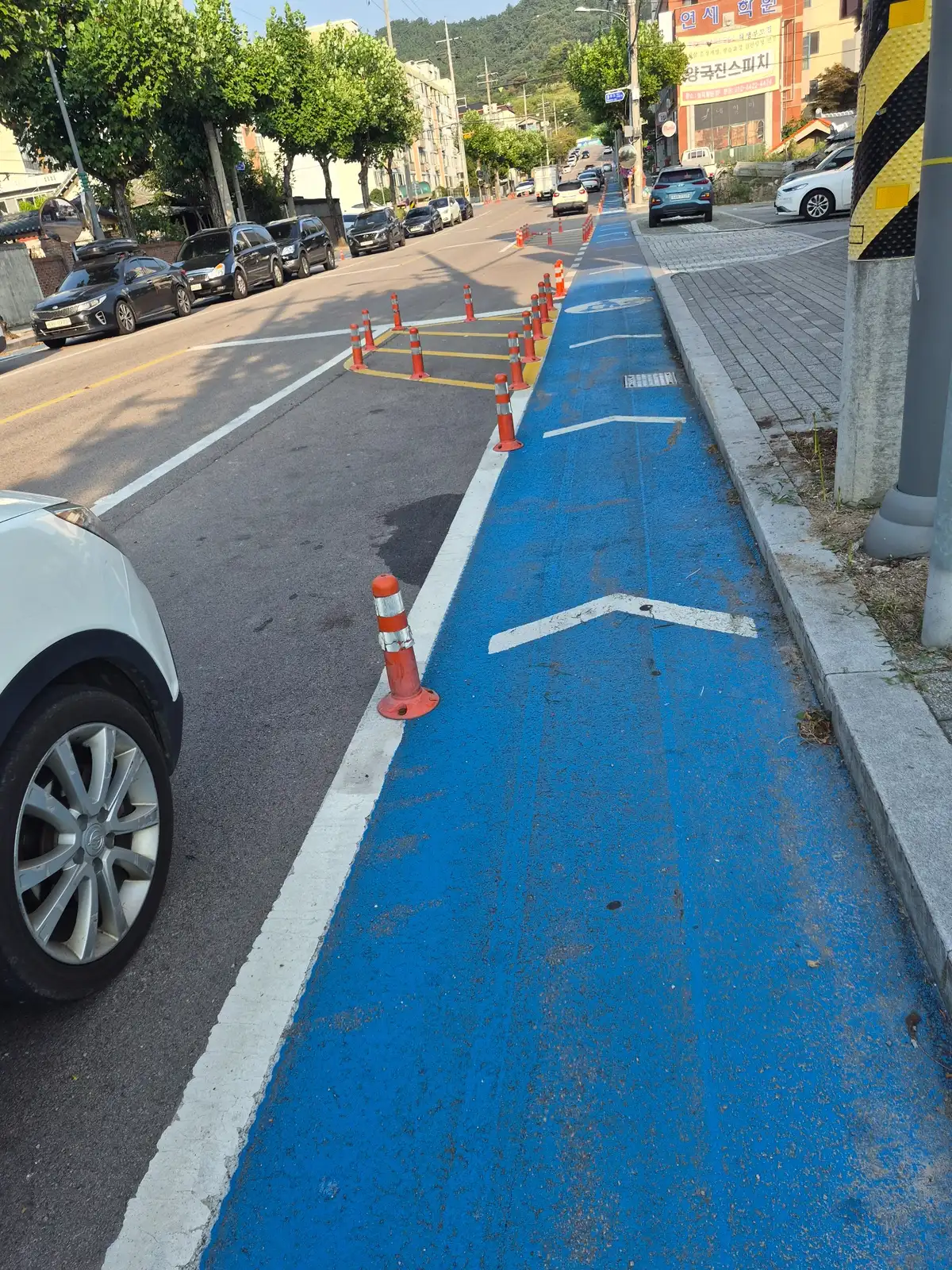
If you walk through downtown Yeonggwang in South Korea, you may notice something unusual beside the road.
A narrow lane painted bright blue runs along the street. White arrows point forward, and a symbol on the pavement shows a person standing on a small electric mobility device.
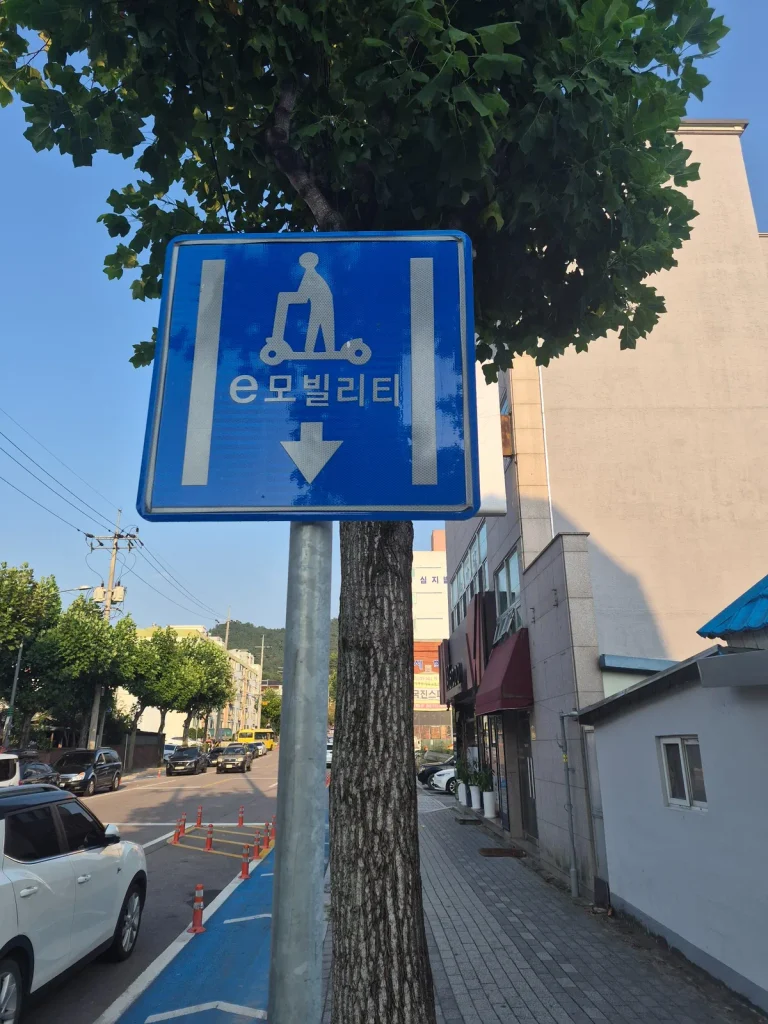
Nearby, a blue road sign makes its purpose clearer: e-Mobility.
It might look like a bicycle lane at first, but this road is connected to a much bigger story about how a small Korean county has been experimenting with new forms of transportation.
What Is an e-Mobility Lane?
The term e-mobility can cover a range of transportation powered by electricity.
In Yeonggwang’s e-mobility projects, this has included small electric vehicles and personal mobility devices such as electric scooters and electric bicycles.
The blue lane in these photographs is part of infrastructure developed in Yeonggwang to provide space for these kinds of smaller mobility devices.
In 2021, Yeonggwang County completed an e-mobility road project in the urban area of Yeonggwang-eup.
The project included two dedicated-lane routes and four priority-road routes, with a combined length of 3.11 kilometers. The project was intended to improve safety for personal mobility users and establish infrastructure for emerging forms of transportation.
Look Down and You Can See What the Road Is For
You do not need to understand Korean to get an idea of what this blue road is designed for.
A large white symbol painted directly on the pavement shows a person standing on a small wheeled mobility device.
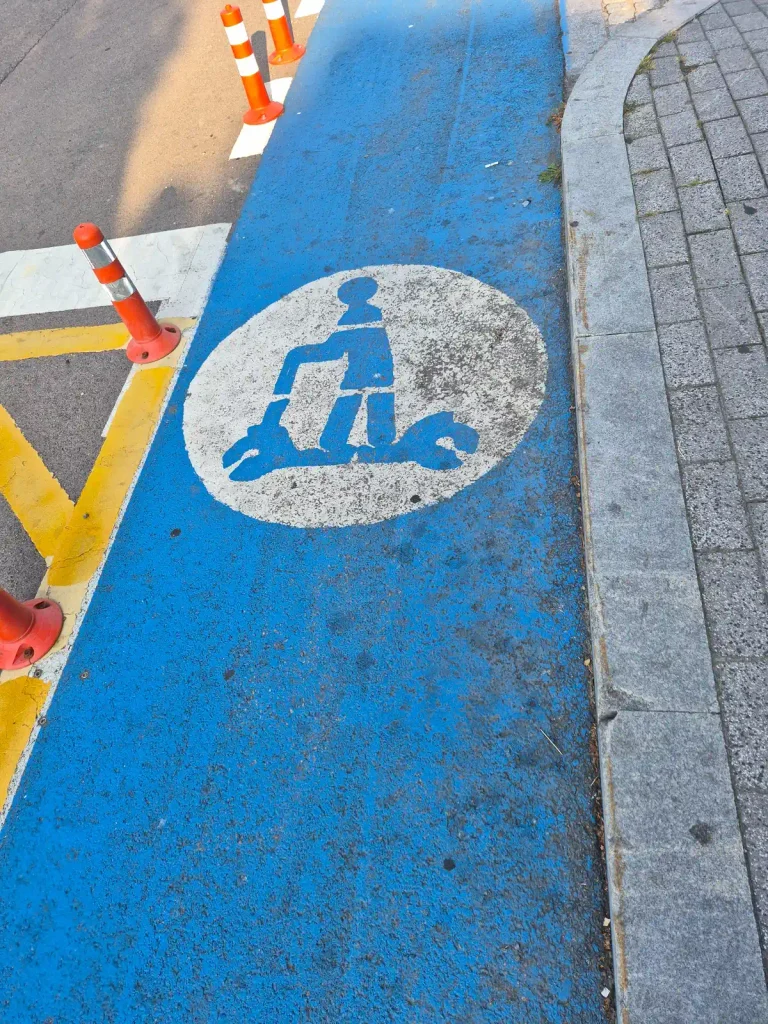
The lane is also separated from ordinary vehicle traffic in some sections by flexible orange posts.
That separation is significant because one of the problems surrounding personal mobility devices in Korea has been deciding how they can move safely through streets that were originally designed mainly for cars, pedestrians and bicycles.
According to a Korean Local Administration Research Institute case study, Yeonggwang designed its e-mobility roads using bicycle-road design standards and developed several types of road space depending on local traffic conditions.
The Sign Actually Says “e-Mobility”
The purpose becomes even clearer when you see the roadside sign.
It shows the same standing rider symbol, together with the Korean text “e모빌리티”, meaning “e-Mobility.”
An arrow underneath indicates the direction of the lane.
For someone visiting Korea, the sign may seem unusual.
That is because this is not simply a road feature found everywhere in the country. It is closely connected with Yeonggwang’s efforts to develop an e-mobility industry and test infrastructure for smaller electric vehicles.
Why Yeonggwang?
This is where the story becomes more interesting.
Yeonggwang is a relatively small county in Jeollanam-do in southwestern Korea, far from the huge urban transportation systems of Seoul.
Yet it has spent years developing an e-mobility industry.
The effort goes back to the 2010s. Jeollanam-do lists Yeonggwang’s Daema Industrial Complex as a center for e-mobility development, with infrastructure for product development, evaluation, certification and testing. The types of vehicles associated with this industry include micro electric cars and electric two-wheelers.
Yeonggwang also became part of a regulatory sandbox program where different forms of electric mobility—including electric bicycles, personal mobility devices and agricultural transport vehicles—could be tested under special regulatory conditions.
In other words, the blue road in downtown Yeonggwang is not an isolated piece of road paint.
It is one visible part of a much larger local industrial strategy.
The Experiment Did Not End in 2021
The original road infrastructure dates back several years, but Yeonggwang’s involvement with e-mobility has continued.
In 2026, government-supported programs were still providing assistance to e-mobility-related companies located in Yeonggwang, including support for prototypes, commercialization, intellectual property and market development.
There has also been further development around future mobility. In July 2026, Yeonggwang was included in a newly designated regulatory special zone involving renewable-energy-based battery-swapping systems and small purpose-built connected vehicles.
So although the blue lane itself may look like a small detail on an ordinary Korean street, the idea behind it is still developing.
A Different Side of Rural Korea
When people outside Korea imagine rural Korea, they may picture rice fields, mountains, traditional houses and quiet villages.
Those things are certainly part of the countryside.
But rural Korea is not frozen in the past.
Small towns and counties are also experimenting with new industries, transportation systems and technologies as they search for ways to build their future.
That is what makes this blue road in Yeonggwang interesting.
At first glance, it is simply a narrow painted lane beside an ordinary street.
Look a little closer, however, and it tells a much bigger story about a small Korean county trying to become a testing ground for the next generation of mobility.